Most astrology confusion starts with a simple mix-up: people treat a birth chart like a pile of personality labels when it works more like a system.
That is the real difference between Sun sign astrology, the Big Three, and a full natal chart reading. They are not competing beliefs. They are different levels of detail. Once that clicks, chart reading becomes less mystical and more practical.
A useful beginner question is not "What does this sign mean?" but "What changes when I add one more layer?" That question makes the chart easier to read and harder to oversimplify.
Sun Sign vs Big Three vs Full Chart
Here is the shortest comparison:
- Sun sign astrology gives one central style of identity, motivation, and expression.
- The Big Three adds emotional pattern and outward style through the Moon and Rising sign.
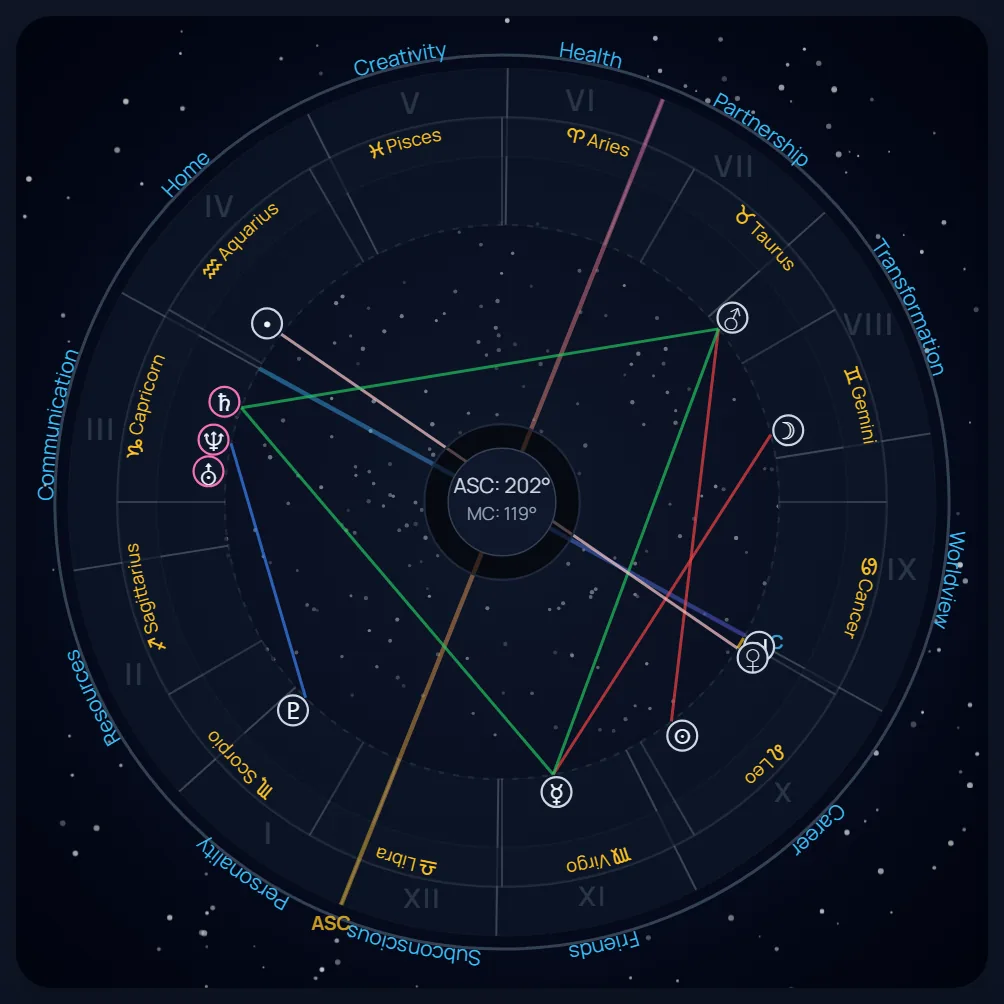
- A full birth chart shows how those parts interact through planets, houses, and aspects.
People often expect a full chart to replace the Big Three. It does not. It tests, qualifies, and sometimes complicates it.
For example, a Sun sign can suggest a broad way of operating. The Moon can show what happens under stress, in private, or in emotional routines. The Rising sign can describe how someone enters situations, handles first impressions, or approaches new environments. A full chart asks a more useful question: Do these parts support each other, clash, or pull attention in different directions?
That is where chart logic begins.
Why the Big Three Feels Accurate and Also Incomplete
The Big Three gets popular because it is the fastest way to move beyond flat Sun sign astrology.
It gives a baseline snapshot:
- Sun: core drive, will, style of self-expression
- Moon: instinctive reactions, comfort needs, inner rhythm
- Rising: approach, presentation, entry point into life
That snapshot is genuinely useful. It can help explain why a person seems unlike their Sun sign stereotype. A calm public style can sit next to a forceful inner drive. A socially warm exterior can coexist with a private need for distance. The Big Three makes room for contrast.
But it still has limits.
It does not tell you:
- where those tendencies show up most strongly
- which themes dominate daily decisions
- whether communication supports or disrupts the rest of the chart
- how ambition, relationships, boundaries, and timing pressures connect
This is why two people with the same Big Three can still read very differently in practice.
Where Beginners Usually Get It Wrong
The most common mistake is reading each placement as a separate trait list.
That produces astrology that sounds tidy but explains very little. A chart is not meant to be read as:
- Sun means this
- Moon means that
- Rising means another thing
- done
A better method is to compare functions.
Ask:
- Is the chart showing one repeated style or mixed signals?
- Does the public approach match the private emotional pattern?
- Does the core drive move easily, or does it keep hitting friction?
- Are several placements pointing toward the same life theme?
That shift matters because chart reading is less about collecting meanings and more about noticing structure.
Big Three Meanings vs Full Chart Meanings
The Big Three tends to answer "What is the baseline style?"
A full chart starts answering questions like:
- Where does that style show up most?
- What supports it?
- What complicates it?
- Which life areas carry more weight?
Here is a practical contrast.
Example 1: Confidence vs caution
A Sun placement may suggest a direct, assertive style. Read alone, that can sound simple: strong will, fast action, visible confidence.
But if the Moon points to caution and the Rising sign is measured, the lived pattern changes. The person may act boldly in principle, then slow down in unfamiliar settings, then process emotions privately before making a final move.
A full chart goes further. It can show whether that tension is central or occasional. It can show whether communication, work habits, or relationships intensify the contrast.
The result is not a contradiction. It is a pattern.
Example 2: Sociable vs selective
A Rising sign may look open, friendly, or socially easy. A Sun sign may support visibility or expression. That can lead to a quick conclusion: outgoing person.
Then the Moon or other chart factors may show strong selectiveness, a need for control over time, or a preference for fewer but deeper exchanges. In practice, that may look less like constant sociability and more like being engaging on arrival but careful about closeness.
Again, the chart becomes clearer when read as a set of interacting functions rather than labels.
What Changes Beyond Sun Sign Astrology
The jump from Sun sign astrology to chart reading changes three things.
1. Personality becomes layered, not flattened
Sun sign astrology often treats one sign as the whole story. The chart shows multiple operating styles at once.
This is why astrology feels more recognizable when readers move beyond Sun signs. Not because it becomes magical, but because it stops forcing one category to explain everything.
2. Context starts to matter
In a full chart, placements are not floating in space. Houses show life areas. Aspects show relationships between parts of the chart.
That matters in practice. A communication pattern does not mean much until you know whether it supports work, complicates relationships, or adds pressure to decision-making.
3. Repetition matters more than any single placement
One isolated placement can be interesting. Repeated signals are more useful.
If several chart factors point toward independence, privacy, intensity, adaptability, or structure, that repeated theme deserves more attention than one dramatic placement read in isolation.
This is one of the simplest forms of practical astrology: look for pattern density, not one-off labels.
What a Beginner Should Read First in a Natal Chart
If the goal is clarity, not information overload, use this reading order.
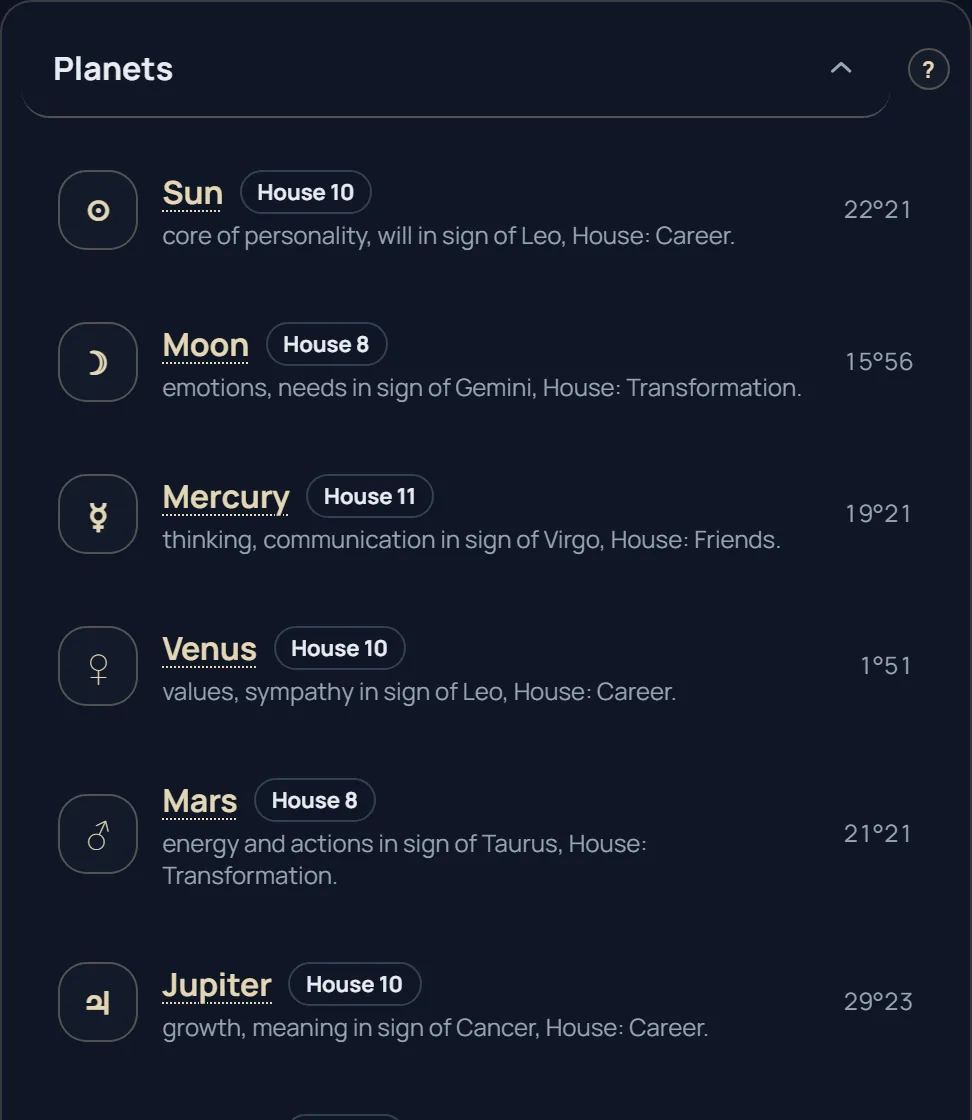
Start with the Big Three
The Big Three gives the cleanest first snapshot. It helps answer:
- What is the basic style of identity?
- What is the emotional operating system?
- How does the person tend to meet the world?
This is the best first step for most beginners because it introduces contrast without requiring full chart technique.
For a simpler introduction to chart structure, see What Is a Natal Chart? A Clear Beginner Guide to Birth Chart Meaning.
Then look for agreement or tension
Do the Sun, Moon, and Rising seem to pull in the same direction, or not?
A chart with strong agreement often reads more consistently. A chart with obvious tension may show someone who presents one way, feels another way, and acts from a third motive under pressure.
That is not a flaw. It is useful reading information.
Then add houses and aspects
This is where a chart stops being a profile and starts becoming a system.
- Houses show where themes tend to concentrate.
- Aspects show whether different parts of the chart cooperate, ignore each other, or create friction.
If beginners skip straight to dozens of placements, they often lose the plot. The sequence matters.
A solid next step is Understanding a Birth Chart Step by Step: What to Read First.
The Difference Between Traits and Themes
Another useful comparison is traits vs themes.
Traits are the adjectives people collect from astrology posts: bold, sensitive, private, stubborn, charming, analytical.
Themes are broader and more useful. They describe recurring pressures and priorities, such as:
- balancing independence with partnership
- needing both recognition and privacy
- moving between speed and caution
- preferring stability while also craving change
- learning when to push and when to pause
Traits can sound accurate and still be shallow. Themes are what make a reading feel connected to real decisions.
For example, "independent" is a trait. "Frequently choosing autonomy even when cooperation would be easier" is a theme with practical consequences.
That is the level where birth chart patterns become readable.
How to Read a Chart as a System Rather Than a Label Set
A clean system-based method looks like this:
- Find the baseline with Sun, Moon, and Rising.
- Note contrast between public style, private needs, and core motivation.
- Check repetition across other placements.
- Use houses to locate where those patterns matter most.
- Use aspects to see whether the chart supports ease, friction, or compensation.
- Summarize in themes, not disconnected traits.
That final step is where many readings improve. Instead of saying a chart is expressive, cautious, and idealistic, say something more usable: the chart suggests a recurring tension between visible self-expression and careful emotional control.
That is specific enough to be meaningful without pretending to be absolute.
If the jargon is still getting in the way, How to Read Your Birth Chart Without Getting Lost in Astrology Terms is a useful companion.
What “Life Direction” Means in a Practical Reading
People often expect astrology to hand over a fixed life purpose. That is where the conversation usually goes off course.
In practical reading, life direction is better understood as recurring orientation rather than a guaranteed fate. The chart may highlight where effort tends to gather, what kinds of growth tensions repeat, or which settings bring certain strengths and frictions into focus.
That is a much more grounded use of astrology.
Instead of asking, "What is the one destiny?" a better question is:
- Which themes keep returning?
- What kind of environment draws out the chart's strongest patterns?
- Where does growth seem to require discomfort, structure, or adjustment?
This keeps the reading useful without turning it into prediction theater.
FAQ
Is the Big Three enough to understand a birth chart?
Enough for a strong first impression, yes. Enough for a full reading, no. The Big Three gives a baseline. A full chart shows how that baseline works in context.
Why do people with the same Sun sign seem so different?
Because Sun sign astrology covers only one layer. The Moon, Rising sign, houses, and aspects can change how that Sun style shows up in behavior, priorities, and social situations.
What should a beginner learn after Sun, Moon, and Rising?
Learn houses first, then aspects. Houses show where themes land. Aspects show how different parts of the chart interact.
Is a full chart more accurate than Sun sign astrology?
It is more detailed, which usually makes it more nuanced. But astrology still works best as a reflection framework, not as objective proof about a person.
How can a chart be read logically?
Read it in layers. Start with the Big Three, compare them, look for repeated themes, then use houses and aspects to explain where and how those themes operate.
Final takeaway
The best comparison is not Big Three versus full chart as if one must defeat the other. The Big Three gives the outline. The full chart adds structure, context, and pattern.
That shift changes astrology from label collecting into a reading method. And for beginners, that is the point where a birth chart starts making sense.