Reading a birth chart gets confusing fast because most beginner guides hand over every term at once. A better approach is to read it in layers.
The first layer is simple: who you are at the core, what you need emotionally, and how you meet the world. In astrology, that usually starts with the Sun, Moon, and Rising signs. Those three placements will not explain everything, but they give a usable baseline before you touch aspects, nodes, dignities, or other advanced terms.
If the goal is to understand how to read a birth chart without jargon, start with the parts that change how a person shows up in everyday life. Leave the specialized vocabulary for later.
What a birth chart is, in plain English
A birth chart is a map of where the Sun, Moon, and planets appeared from Earth at the moment of birth. Astrology uses that map as a symbolic framework for describing patterns: temperament, emotional habits, priorities, and areas of life that tend to get attention.
That is why a full chart goes beyond Sun sign astrology. Two people with the same Sun sign may still come across very differently if their Moon, Rising, and house placements point in different directions.
If you want a broader foundation first, see What Is a Natal Chart? A Clear Beginner Guide to Birth Chart Meaning.
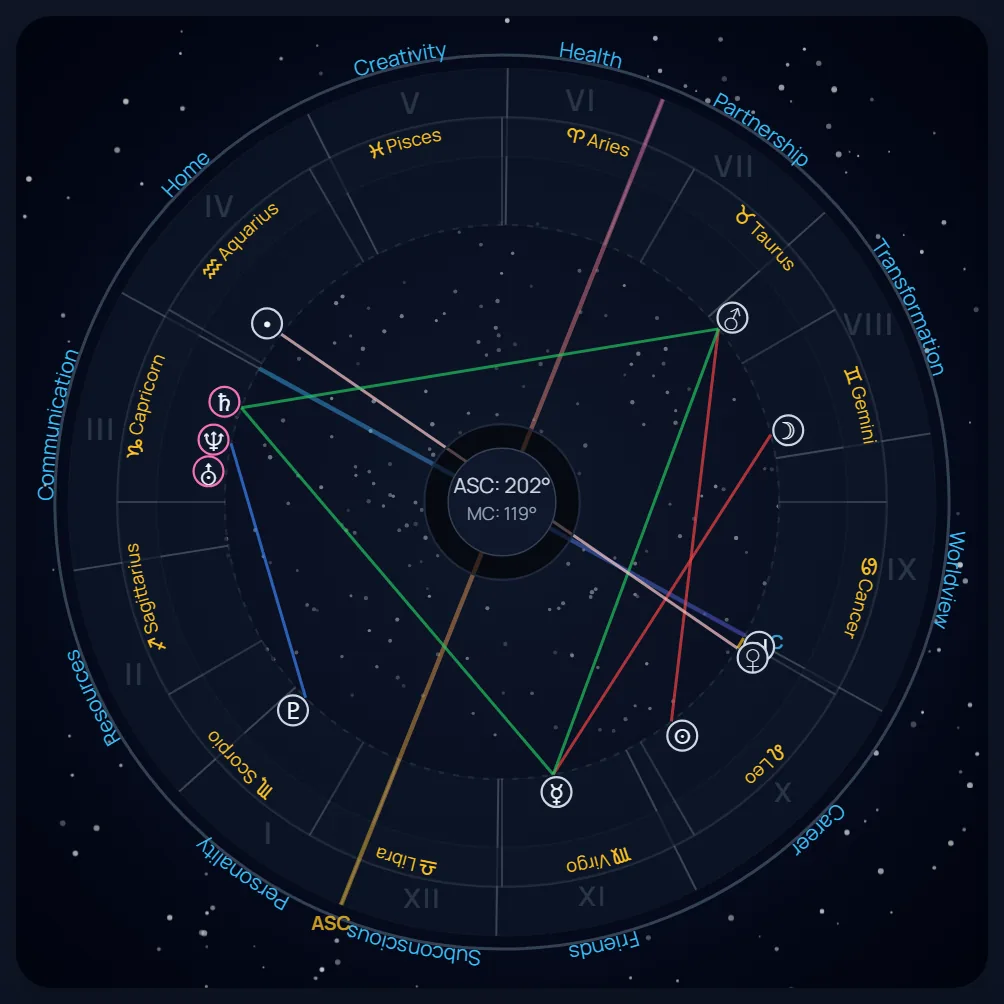
The only chart elements a beginner should read first
A full chart contains many moving parts. A beginner does not need all of them on day one.
Read these first:
- Sun sign
- Moon sign
- Rising sign
- The houses those three fall into
- A quick scan of any strong repeats
That order matters because it moves from identity, to emotional response, to outward style, to life area.
1. Sun sign: the steady center
The Sun is often treated as the whole chart, but it is better understood as the central style of being. It can describe what feels purposeful, familiar, or energizing.
A practical reading use case: when the Sun is emphasized, people often notice it in how they make decisions, pursue recognition, or define what matters to them.
The Sun is not the mood of the moment. It is closer to the core approach.
2. Moon sign: the emotional operating system
The Moon describes instinctive reactions, comfort needs, and the way feelings get processed. When beginners say, "My Sun sign does not sound like me," the Moon is often part of the missing context.
A practical reading use case: the Moon becomes easier to understand when looking at stress habits, what restores energy, or how someone reacts before they have time to think.
The Moon does not cancel the Sun. It adds the private layer behind the public description.
3. Rising sign: the filter and delivery style
The Rising sign, also called the Ascendant, is the sign on the eastern horizon at birth. In beginner reading, it helps explain first impressions, outward behavior, and the way a person enters new situations.
This is one reason full-chart astrology feels more accurate than generic Sun sign content. A direct Sun sign may be delivered in a measured, quiet, or highly sociable way depending on the Rising sign.
A practical reading use case: think about how someone approaches strangers, starts tasks, handles unfamiliar settings, or gets read before people know them well.
The Big Three as a quick baseline
The Sun, Moon, and Rising are often called the Big Three because they create a fast profile that is actually useful.
Try this frame:
- Sun = core style and what feels central
- Moon = emotional needs and instinctive reactions
- Rising = presentation, approach, and first-contact style
This is the easiest way to read a birth chart without reducing everything to one sign.
A simple example of how the Big Three work together
Imagine this pattern:
- A bold, visible Sun style
- A cautious, privacy-seeking Moon style
- A polite, restrained Rising style
That combination can create a person who has strong drive and presence, but does not reveal feelings quickly and may appear more reserved than their Sun sign alone suggests.
Now flip it:
- A quiet, steady Sun style
- A highly expressive Moon style
- A fast, outgoing Rising style
That can read as socially quick and emotionally readable, even if the core identity is more measured.
The point is not to label a person. The point is to stop expecting one placement to do the whole job.
If you want a deeper plain-English breakdown of chart reading order, see Natal Chart Interpretation in Plain English: A Step-by-Step Beginner Method.
What changes the interpretation beyond Sun sign astrology?
Three things usually change the reading first: the Moon, the Rising sign, and the houses.
Beginners often focus on signs because signs are the most visible part of astrology content. But signs only tell part of the story.
Here is the cleaner framework:
- Planets describe what function is acting
- Signs describe how that function tends to act
- Houses describe where that function tends to show up in life
That means the Sun is not just "identity." It is identity expressed in a sign style and aimed at a life area through a house.
For example:
- A Moon in a practical sign may process feelings through planning, fixing, or organizing.
- That same Moon in a relationship-focused house may show up most clearly in close bonds.
- In a work-focused house, it may show up through routines, duties, or daily pressure.
Same planet. Different expression. Different life area.
The next thing to read after the Big Three: houses
Houses are often where beginner chart reading starts to feel concrete.
If signs answer how, houses answer where.
A house does not describe a mood. It points to a life department where a planet's themes may be easier to notice.
Common beginner examples:
- A strong emphasis on communication houses can point to learning, speaking, writing, or frequent information exchange.
- A strong emphasis on home and roots may show up around private life, family patterns, or the need for a stable base.
- A strong emphasis on shared work, public reputation, or visibility may shape career choices and responsibility style.
You do not need to memorize all twelve houses at once. Start by locating the houses of the Sun, Moon, and Rising ruler if your chart tool shows it. That already adds real depth.
A no-jargon method to read a chart in 10 minutes
Use this sequence when opening any birth chart for the first time.
Step 1: Find the Sun, Moon, and Rising signs
Write down three short phrases:
- Core style
- Emotional needs
- Outward approach
Do not interpret yet. Just identify the baseline.
Step 2: Note whether the three placements feel similar or mixed
Ask:
- Do they all point toward a similar pace or tone?
- Is there tension between private needs and public behavior?
- Does the outer style match the emotional style, or hide it?
This gives the chart its first shape.
Step 3: Check the houses of the Sun and Moon
This shows where the core identity and emotional life may be most active or visible.
If the Sun lands in a house tied to work, visibility, or achievement, the person may put more energy into building and doing. If the Moon lands in a house tied to home or close bonds, emotional life may be processed more through private connection than public expression.
Step 4: Look for repeats
Repeats matter more than isolated details.
Common repeats include:
- Several placements in the same element
- Several placements in the same modality
- Several personal placements clustered in a few houses
- The same themes showing up in both sign style and house emphasis
When a chart repeats one tone, that tone usually matters more than a random single placement.
Step 5: Ignore advanced terms until the basics hold together
A beginner does not need to start with:
- Minor asteroids
- Arabic parts
- Complex aspect patterns
- Essential dignities
- Progressions and transits
Those tools can be useful later. Early on, they often distract from the chart's obvious structure.
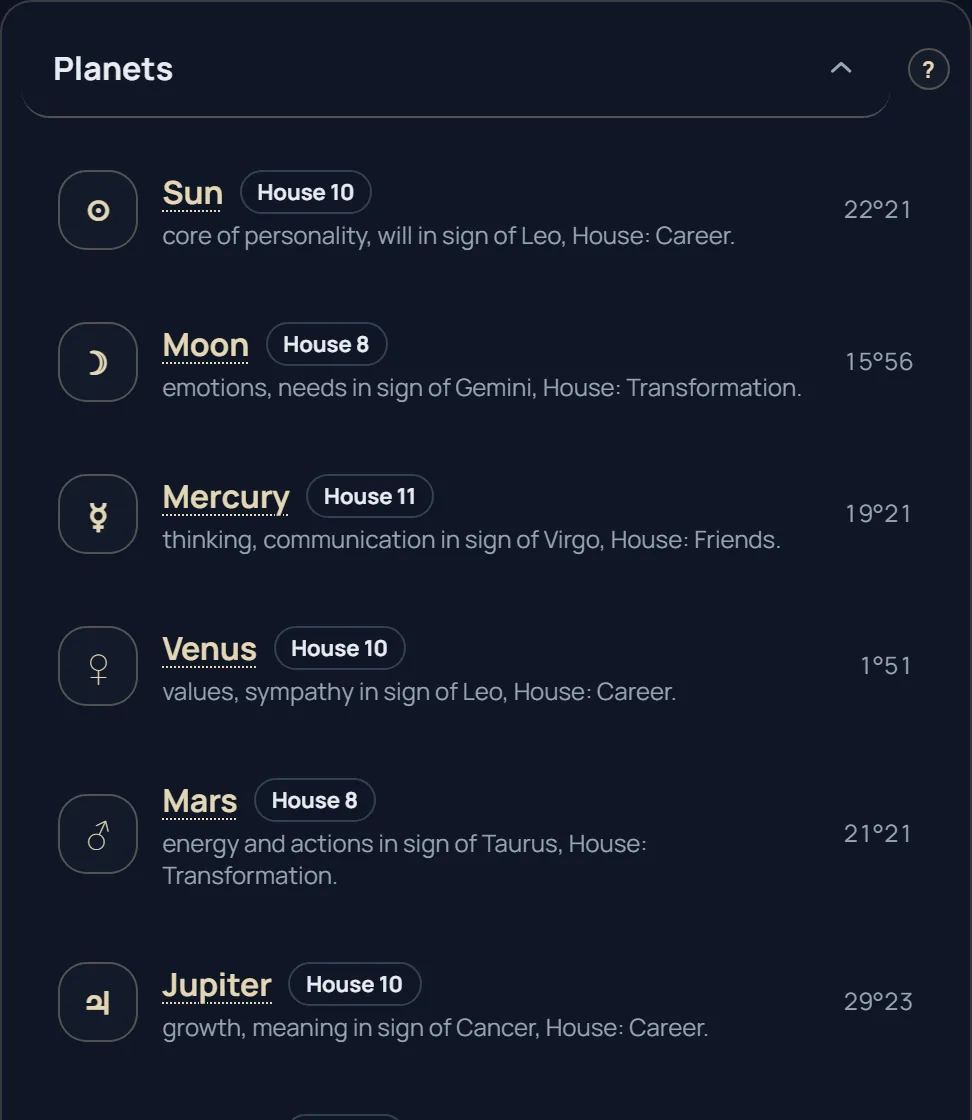
Which astrology terms can wait until later?
Quite a few.
If the goal is a first readable chart, these can wait:
- Orb: how close an aspect is
- Dignity: whether a planet is considered strong or comfortable in a sign
- Retrograde: a special condition that adds nuance but is not the first layer
- Decans and bounds: fine-tuning tools
- Nodes, Chiron, asteroids: useful in some systems, not required for a beginner baseline
Start with the chart parts that explain observable patterns. Leave technical ranking systems for later.
How to tell whether a chart theme is actually important
Beginners often overread one placement and miss the louder themes.
A theme is more worth your attention when it appears in more than one place.
For example, communication may be a stronger theme if:
- The Rising sign is quick or verbal in style
- The Moon processes through talking or naming feelings
- The Sun sits in a learning or communication house
That repeated pattern is more useful than treating one isolated placement as the whole answer.
This is also how a chart starts to suggest broader life themes without turning into a script for fate. Repeated emphasis may help a reader notice what kinds of situations, roles, or tensions keep showing up.
A beginner framework for reading life themes without overclaiming
"Life direction" sounds bigger than it needs to.
In basic chart reading, it usually means this: Which kinds of roles, pressures, and motivations seem to organize a person's attention over time?
A practical way to look for that:
- Start with the Sun for central drive
- Use the Moon for emotional maintenance needs
- Use the Rising for approach and visibility
- Check houses to see where those themes concentrate
- Notice repeats before making any broad statement
This does not predict a single path. It offers a reflection framework for understanding why some environments feel natural, draining, motivating, or friction-heavy.
For a closer look at the difference between chart reading and one-sign astrology, see Natal Chart Reading vs Sun Sign Astrology: What Actually Changes.
The most common beginner mistakes
Treating the Sun sign as the whole personality
The Sun matters, but it is only one layer.
Reading every placement with equal weight
The Big Three and their houses usually deserve attention first.
Memorizing keywords without context
A sign keyword becomes useful only when attached to a planet and a house.
Chasing advanced details too early
A chart is easier to understand when the main structure is clear before the fine print.
Turning the chart into certainty
Astrology can offer a language for patterns and choices. It is not objective proof about a person, and it is not a reliable shortcut to knowing exact outcomes.
FAQ
Which chart elements matter first?
Start with the Sun, Moon, and Rising signs, then check the houses of the Sun and Moon. That gives a beginner the fastest useful overview.
What should a beginner read first in a natal chart?
Read the Big Three first because they describe core style, emotional needs, and outward approach. After that, houses help place those themes in real life.
Which astrology terms can wait until later?
Terms like orb, dignity, decans, minor asteroids, and complex aspect patterns can wait. They add nuance, but they are not necessary for a first readable chart.
What changes the interpretation beyond Sun sign astrology?
The Moon, Rising sign, and houses change the reading the most at the beginner level. They explain why the same Sun sign can show up in very different ways.
Can you read a birth chart without knowing every symbol?
Yes. A beginner can get real value by understanding planets, signs, and houses at a basic level, especially through the Sun, Moon, and Rising.
A simple way to start
When reading a chart for the first time, ask four questions:
- What is the core style?
- What does the emotional system need?
- How does the person come across at first?
- Where do those themes show up most clearly?
That is enough to begin reading a birth chart in a way that is practical, clear, and not buried under jargon.