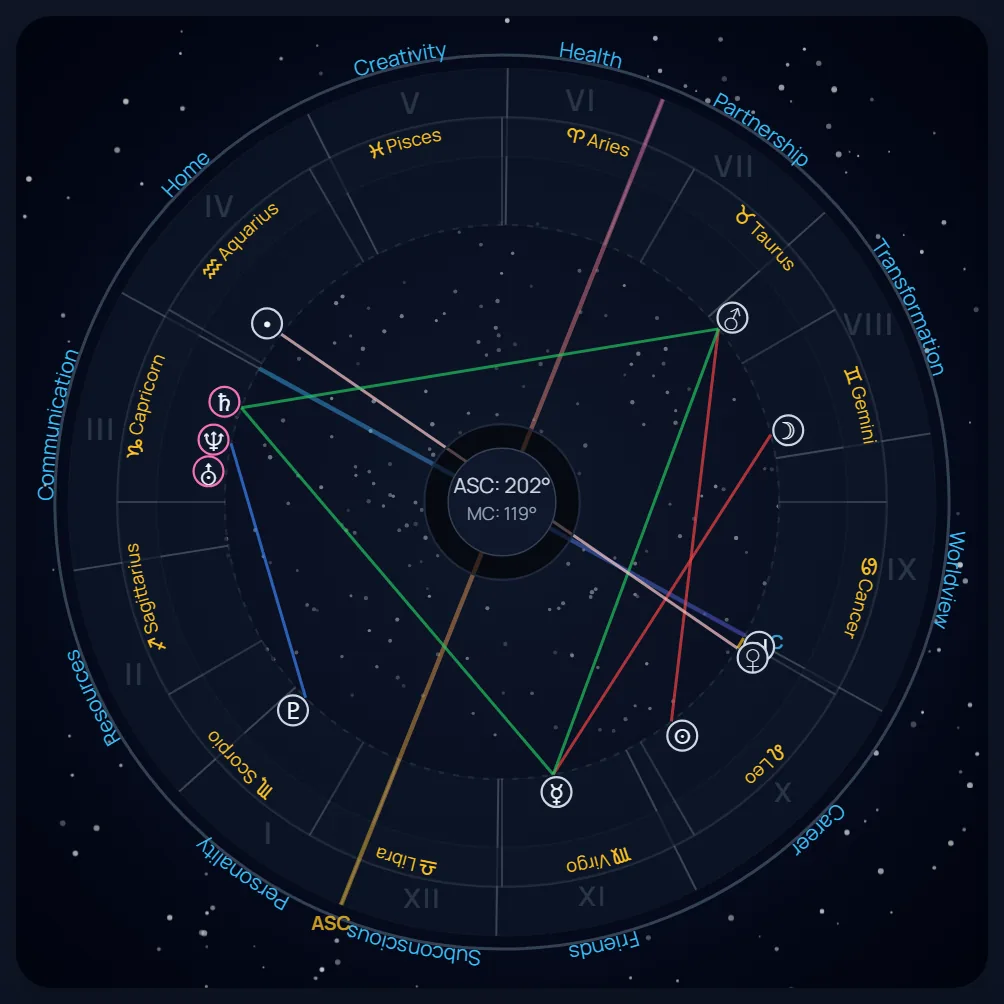
A natal chart is a snapshot of the sky from the moment and place of birth. In astrology, that snapshot is used as a framework for reading personality patterns, motivations, pressures, and recurring life themes.
The key point for beginners is simple: a natal chart is not just a Sun sign. It combines planets, signs, houses, and angles into one system. That is why two people with the same Sun sign can come across very differently.
If astrology has ever felt vague, the natal chart is where it becomes more specific. Not certain. Not predictive in a rigid way. But more detailed, because it asks better questions than a one-sign horoscope does.
What information does a natal chart contain?
A natal chart is built from three pieces of birth data:
- Date of birth
- Exact birth time
- Birth location
Those details are used to calculate where the planets appeared in the sky and which part of the chart each one falls into.
A standard natal chart includes:
- Planets: the main functions or drives being described
- Signs: the style or tone those functions take on
- Houses: the life areas where those themes tend to show up
- Aspects: the relationships between planets
- Angles: especially the Ascendant, which helps shape the chart layout
A practical way to think about it:
- A planet shows what is happening
- A sign shows how it tends to happen
- A house shows where it is most noticeable
- An aspect shows how different parts of the chart cooperate or clash
That framework turns astrology from label collecting into actual interpretation.
What a natal chart means beyond Sun sign astrology
Sun sign astrology reduces the whole chart to one placement: the sign the Sun was in at birth. That can be useful at a very broad level, but it leaves out most of the structure.
A natal chart adds context. The Moon may describe emotional habits. The Rising sign may shape first impressions and instinctive style. Mercury may show how someone processes information. Saturn may point to areas of pressure, discipline, or slow growth.
This is the basic reason natal astrology feels more layered than pop-horoscope content. It is not asking, "What sign is this person?" It is asking, "How do multiple traits and tensions work together?"
For a fuller comparison, see Natal Chart Reading vs Sun Sign Astrology: What Actually Changes.
Where should a beginner start?
Start with the Big Three:
- Sun sign
- Moon sign
- Rising sign or Ascendant
These three placements give a usable first snapshot without requiring a full technical reading.
Sun sign: core drive and basic style
The Sun is often treated as the center of identity in astrology. In beginner terms, it points to a person’s basic way of being, creating, choosing, and expressing purpose.
A practical reading use: the Sun can describe what kind of approach feels most natural when someone is trying to act with confidence or stay true to their priorities.
Moon sign: emotional pattern and inner response
The Moon is usually read as the emotional side of the chart. It can point to comfort needs, stress responses, and what helps a person feel settled.
A practical reading use: when someone seems capable on the surface but reacts strongly under pressure, the Moon often adds useful context that the Sun sign alone misses.
Rising sign: approach, first impression, and entry point
The Rising sign is the sign on the eastern horizon at the birth moment. For beginners, it helps to think of it as the chart’s front door.
It often relates to how a person meets new situations, how they come across at first, and how the rest of the chart is organized into houses.
A practical reading use: two people may share the same Sun and Moon but still move through the world differently because their Rising signs frame the whole chart in different ways.
If the Big Three are your first stop, this guide goes deeper: How to Read a Natal Chart: A Beginner’s Guide to the Big Three and Beyond.
A simple beginner framework for reading a chart
The easiest way to avoid overwhelm is to read in layers.
1. Read the Big Three first
This gives a baseline picture:
- Sun: core style
- Moon: inner response
- Rising: outward approach
Together, these can explain why someone seems more complex than their Sun sign description.
Example:
- A direct, expressive Sun might suggest a visible, confident style.
- A private Moon can add caution or emotional selectiveness.
- A reserved Rising can make the first impression quieter than the Sun placement would suggest.
None of those pieces cancel the others. They modify the overall picture.
2. Look at personal planets next
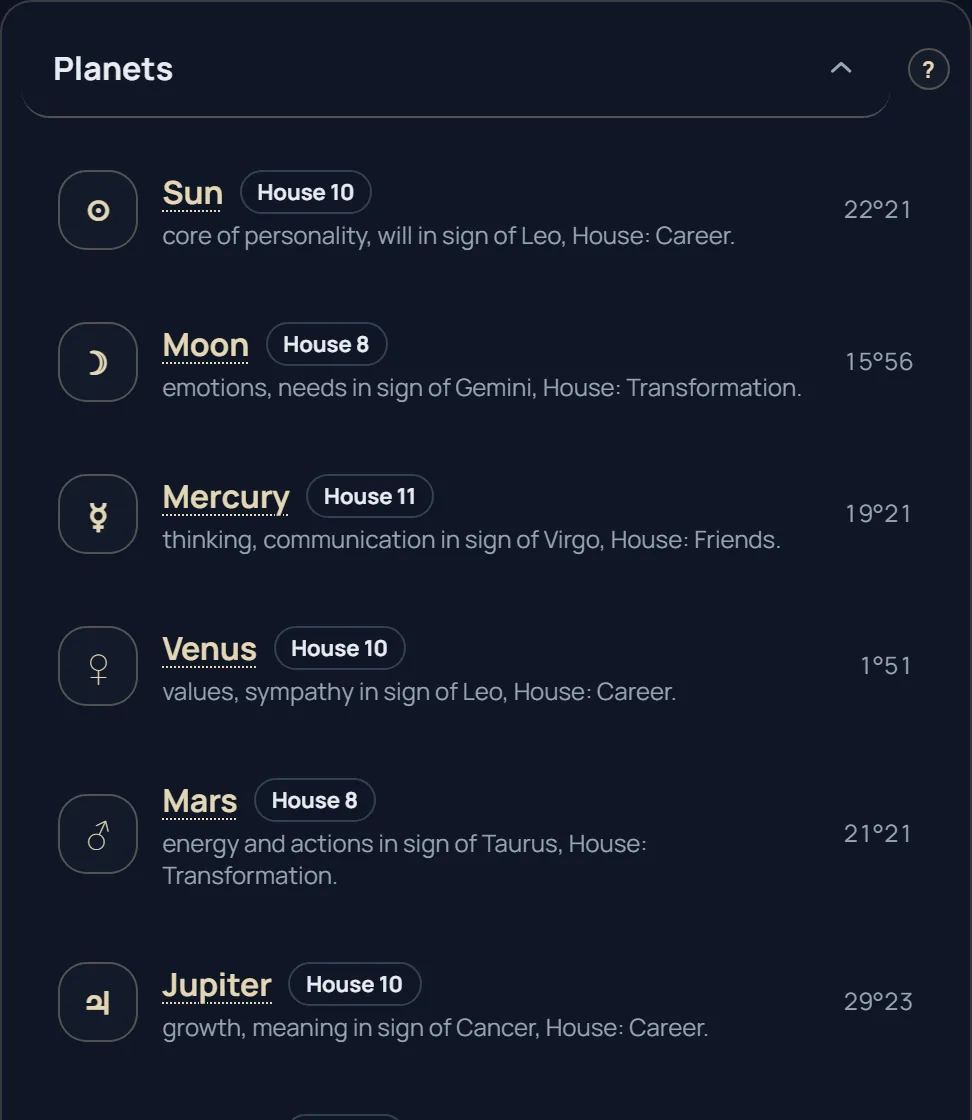
After the Big Three, beginners usually get the most value from:
- Mercury for thinking and communication
- Venus for taste, relating style, and preferences
- Mars for drive, effort, and conflict style
These placements make the chart more concrete.
For example:
- Mercury can show whether someone processes quickly, carefully, broadly, or skeptically.
- Venus can describe what feels appealing, easy, or socially natural.
- Mars can suggest whether action tends to be direct, strategic, hesitant, or persistent.
This is often where astrology starts to feel useful in everyday terms. It moves from identity labels into communication habits, work rhythm, and friction points.
3. Add the houses
Houses show where chart themes tend to play out.
A planet in a sign gives one layer of meaning. Its house placement gives that meaning a setting.
Example:
- Venus can describe style and attraction in general.
- Venus in one house may show up most in close relationships.
- In another, it may show up more through work, reputation, learning, or daily routines.
This is one reason exact birth time matters. Without it, house placement and Rising sign may be unreliable.
4. Check the aspects
Aspects are the angles planets make to one another. They describe how chart parts interact.
This matters because a chart is not a pile of separate placements. It is a pattern.
Example:
- A strong Mars might suggest direct action.
- But if Mars is in a tense aspect with Saturn, action may meet hesitation, delay, or self-control.
- If Mars connects smoothly with Mercury, ideas and action may support each other more easily.
Aspects often explain the difference between a flat keyword reading and a chart that feels coherent.
What should a beginner read first in a natal chart?
If the goal is a quick but meaningful first pass, read in this order:
- Sun
- Moon
- Rising sign
- Mercury, Venus, and Mars
- House placements of the Big Three and personal planets
- Major aspects
That order works because it starts with the clearest personal themes before moving into technical structure.
If you want a focused entry point, Birth Chart Basics: What to Read First and How to Make Sense of It breaks that sequence down further.
How the chart points to life themes without making fixed predictions
Beginners often hear that a natal chart shows "life direction" and assume that means fate. A better way to read it is this: the chart can offer a framework for noticing repeated themes, not a script that removes choice.
Life themes in astrology usually come from patterns such as:
- Repeated emphasis on certain signs or houses
- Strong aspects involving major planets or angles
- Tension between different needs, such as security versus freedom
- Concentration of planets in particular life areas
A concrete example:
If a chart strongly emphasizes work, structure, or public-facing houses, that may point to recurring attention on responsibility, visibility, or long-term goals. That does not guarantee career outcomes. It simply suggests where effort, pressure, or identity investment may be more noticeable.
The same logic applies to relationships, home life, study, creativity, or communication. A natal chart is most useful when it names the pattern clearly enough to reflect on it in real life.
Common beginner mistakes
Reading placements as isolated keywords
A sign description on its own is rarely enough. A planet means something different depending on the house and aspects around it.
Treating one placement as the whole chart
The Sun matters, but it does not override everything else. The same goes for the Moon or Rising.
Using astrology like a certainty machine
A natal chart can help a reader think about tendencies, blind spots, or recurring tensions. It cannot prove facts about a person or predict exact life events.
Ignoring the birth time issue
If the birth time is unknown or estimated, the Rising sign and houses may be off. That changes interpretation.
A quick example of how chart pieces work together
Imagine a beginner trying to understand why one person seems confident at work but guarded in private conversations.
A Sun sign alone might describe confidence. That sounds neat, but incomplete.
A fuller natal-chart approach might ask:
- What does the Moon say about emotional privacy or reassurance needs?
- What does the Rising sign suggest about the first impression?
- Is Mercury cautious, intense, or highly analytical?
- Are there aspects involving Saturn that add restraint or self-monitoring?
- Which houses are emphasized, and in what life areas?
That is the practical value of natal chart basics. The chart does not replace observation. It gives a better structure for it.
FAQ
Is a natal chart the same as a birth chart?
Yes. The terms are commonly used interchangeably. Both refer to the astrological chart based on birth date, time, and location.
Can I read a natal chart without my birth time?
Partly. Planetary sign placements may still be available, but the Rising sign and house placements may be inaccurate or missing. That limits the reading.
Why do the Sun, Moon, and Rising matter so much?
They give a fast core snapshot. The Sun points to basic style, the Moon to inner response, and the Rising sign to outward approach and chart structure.
What changes the interpretation beyond Sun sign astrology?
The biggest changes come from adding the Moon, Rising, houses, and aspects. Those layers show how different traits combine instead of flattening everything into one sign description.
Do beginners need to learn every planet at once?
No. Start with the Big Three, then add Mercury, Venus, and Mars. After that, learn houses and major aspects. That order keeps the chart readable.
Final takeaway
A natal chart is a structured map, not a personality shortcut. For beginners, the best place to start is the Big Three, then build outward through personal planets, houses, and aspects.
That approach keeps astrology readable and grounded. It also answers the question behind most beginner searches: not just what a natal chart is, but why it gives a fuller picture than Sun sign astrology alone.