A natal chart can look crowded at first: symbols, lines, houses, planets, and terms that seem to require a decoder ring. The good news is that beginners do not need to read everything at once. A useful natal chart reading starts with a simple question: what is the core pattern here?
That pattern usually becomes clearer when you begin with the Big Three: the Sun, Moon, and Rising sign. From there, you add planets, houses, and aspects to understand how the chart becomes more specific than basic Sun sign astrology.
What a natal chart actually is
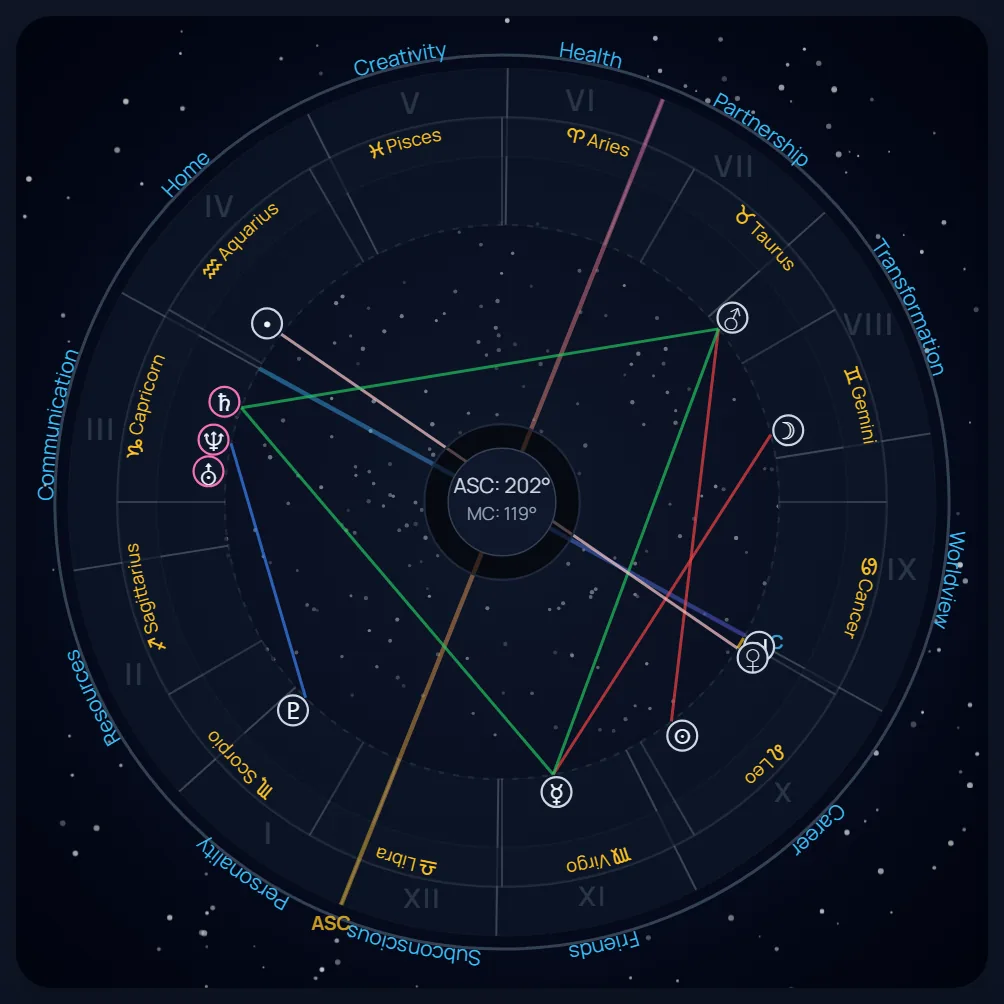
A natal chart, also called a birth chart, is a map of where the planets appeared in the sky at the moment of birth, from a specific place on Earth. Astrology uses that map as a symbolic framework for reading temperament, habits, priorities, and recurring life themes.
For beginners, the key point is this: a natal chart is not just one sign. It is a system of layers.
That is why two people with the same Sun sign can feel very different in real life. One may come across as direct and competitive, while another is careful, private, or socially smooth. The full chart explains that difference.
What should a beginner read first in a natal chart?
Start in this order:
- Sun sign — basic identity, drive, and style of expression
- Moon sign — emotional habits, instinctive reactions, and comfort needs
- Rising sign — outward approach, first impression, and how life is met
- The houses of the Sun, Moon, and chart ruler — where those patterns show up most strongly
- Major aspects — how those parts support, complicate, or pressure each other
This gives a usable baseline before you try to interpret every planet and every line in the chart.
The Big Three: the fastest way to get a core snapshot
The Big Three matter because they describe three different but connected levels of personality.
Sun sign: the central style
The Sun points to the kind of qualities a person tends to build around: confidence, purpose, self-expression, and the way they want to matter.
A Sun sign is not the whole chart, but it often shows the style of effort that feels most natural. For example:
- A fire Sun may push toward action, visibility, or self-direction.
- An earth Sun may focus on stability, competence, or practical results.
- An air Sun may lead with ideas, language, or social exchange.
- A water Sun may prioritize feeling, sensitivity, or emotional meaning.
Concrete use case: if a chart has a bold Sun sign, that does not automatically mean a loud personality. If the Moon and Rising are more reserved, the person may still need privacy, caution, or time to warm up.
Moon sign: the emotional operating system
The Moon describes what helps someone feel safe, settled, and emotionally regulated. It also shows what tends to happen under stress before conscious control kicks in.
This is one reason Sun sign astrology often feels incomplete. The Sun may describe what someone aims to be, while the Moon shows what they do when tired, reactive, or vulnerable.
Concrete use case: a chart with a highly social Sun but a private Moon may enjoy people and still need a lot of retreat time afterward. Without the Moon, that pattern can look inconsistent. With the Moon, it makes sense.
Rising sign: how the chart enters the room
The Rising sign, or Ascendant, is the sign rising on the eastern horizon at the time of birth. In beginner terms, it shows how someone approaches new situations and how others tend to read them at first.
It is not just a mask. It is more like the front door of the chart.
The Rising sign also matters because it sets the house structure. Once the Ascendant is known, astrologers can place the rest of the chart into life areas such as work, relationships, home, money, and friendship.
Concrete use case: if the Sun describes ambition and the Moon describes emotional caution, the Rising sign may show whether that mix comes out as confident, diplomatic, guarded, intense, or adaptable in everyday interactions.
Why Sun sign astrology is only the starting point
Sun sign astrology is popular because it is simple and easy to remember. But it leaves out three major things:
- Emotional patterning from the Moon
- Behavioral style and life approach from the Rising sign
- Context from houses and aspects
That is what changes interpretation beyond Sun sign astrology.
Take a basic example. Two charts may share the same Sun sign:
- Chart A has a Moon in an impulsive fire sign and a Rising sign that acts fast.
- Chart B has a Moon in a cautious earth sign and a Rising sign that hangs back.
The same Sun can express itself very differently through those two structures. One pattern may act quickly and learn by trial and error. The other may need proof, routine, and a slower decision process.
This is why natal chart reading works best as pattern reading, not label collecting.
The next layer: planets, houses, and aspects
Once the Big Three make sense, the rest of the chart becomes easier to read.
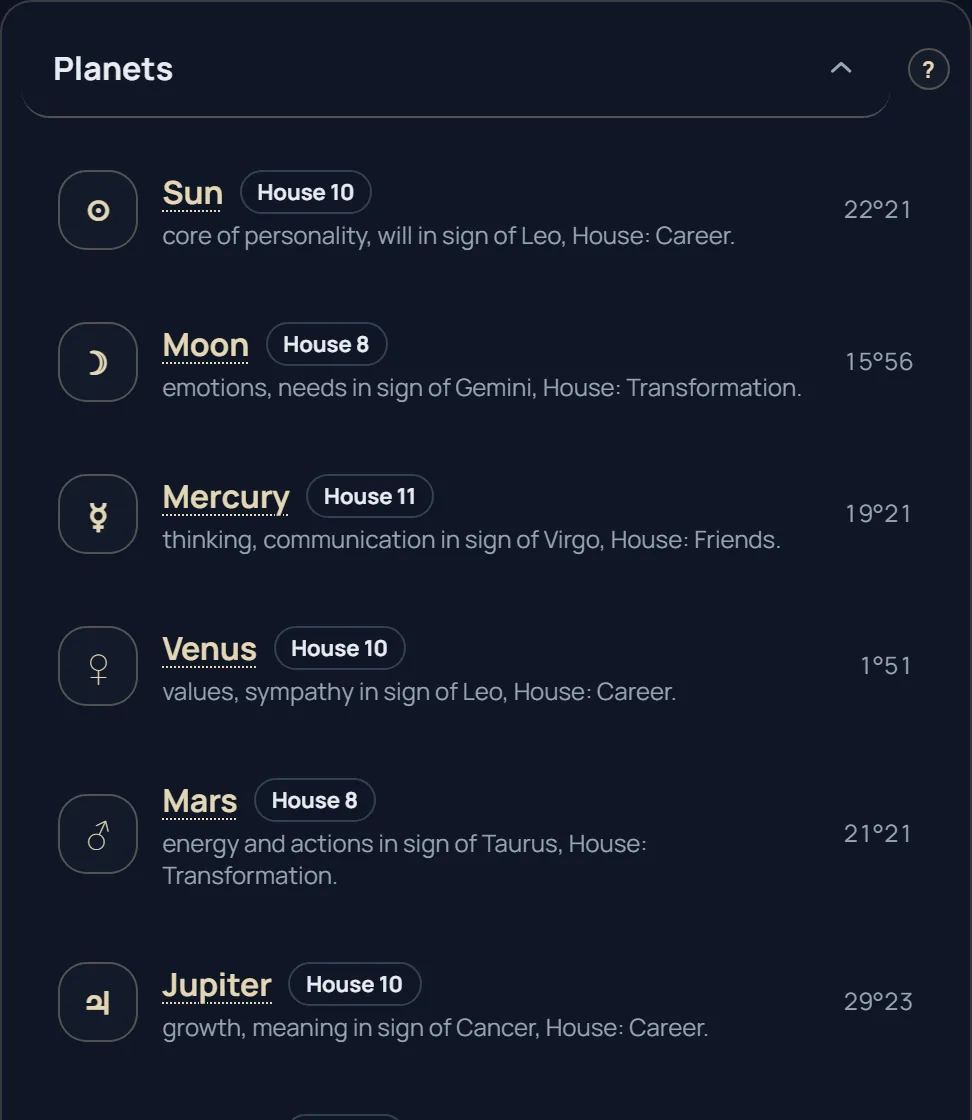
Planets: what part of life function is involved
Each planet points to a different function.
- Mercury: thinking, speaking, processing information
- Venus: attraction, taste, relating, values
- Mars: action, anger, drive, effort
- Jupiter: growth, confidence, belief, expansion
- Saturn: pressure, limits, discipline, responsibility
Beginners do not need to memorize every traditional meaning at once. A practical shortcut is to ask: what human function does this planet describe?
Signs: how that function behaves
A planet in a sign shows style.
For example, Mercury changes how thinking and communication tend to work:
- Mercury in an earth sign may prefer clear facts and useful details.
- Mercury in an air sign may move quickly through ideas and comparisons.
- Mercury in a water sign may read tone, subtext, and feeling first.
Houses: where the pattern tends to show up
Houses bring the reading down to real life. They describe the area of experience where a planet’s themes are most active.
Examples:
- A planet in the 2nd house may show up strongly in money, resources, or self-worth.
- A planet in the 4th house may concentrate around home, family, roots, or private life.
- A planet in the 10th house may show up in work, status, reputation, or public direction.
If signs answer how, houses answer where.
Aspects: how parts of the chart interact
Aspects are the angles between planets. They show whether two functions work smoothly together, clash, or create ongoing pressure.
A simple beginner frame:
- Trines and sextiles often show easier flow.
- Squares and oppositions often show friction, adjustment, or inner conflict.
- Conjunctions intensify and blend two functions.
Concrete use case: a person may value harmony in relationships but still react sharply under stress. That contradiction often becomes clear when Venus and Mars are in a tense aspect. The chart stops looking random and starts looking coherent.
A simple beginner framework for reading a natal chart
Use this five-step method when looking at any chart.
1. Find the Big Three
Write down the Sun sign, Moon sign, and Rising sign first. Ask:
- What is the central style of identity here?
- What emotional needs or reflexes stand out?
- How does the person meet the world?
Look for agreement or tension between those three. If all three lean toward speed and directness, the baseline may be more straightforward. If one wants action, one wants safety, and one wants control, the chart may carry more inner negotiation.
2. Check where the Sun and Moon fall by house
The house placement shows where those needs and priorities play out most visibly.
Examples:
- A Sun in the 10th house may push toward achievement, leadership, or public recognition.
- A Moon in the 4th house may heighten the need for privacy, home base, or emotional grounding.
This quickly turns abstract symbols into life themes.
3. Find the chart ruler
The chart ruler is the planet that rules the Rising sign. It helps show how the whole chart tends to operate.
For example, if the Rising sign is ruled by Mars, then Mars becomes especially important. Its sign, house, and aspects can tell you a lot about how initiative, pressure, and decision-making function overall.
Beginners often skip this step, but it is one of the fastest ways to make a chart feel connected instead of scattered.
4. Notice repeated themes
Look for repetition rather than isolated meanings.
Patterns to notice:
- Several planets in one element, such as fire or water
- Several planets in one house area, such as work or relationships
- Repeated tension around one planet, such as Saturn or Mars
Repetition usually matters more than one standout placement. If multiple chart features point toward the same issue, that theme is likely central.
5. End with a plain-language summary
A good natal chart reading should be easy to say out loud.
For example:
- Strong outward drive, but a private emotional core
- Quick mind, but cautious follow-through
- Big need for independence, with pressure around partnership
- Public ambition, supported by strong routines and practical judgment
If the summary sounds vague or overly magical, go back and simplify.
Common beginner mistakes
Reading one placement in isolation
One sign or planet never tells the whole story. The chart works as a system.
Treating the chart like a fixed fate script
Natal charts are better used as maps of tendencies, strengths, friction points, and recurring pressures. They do not remove choice.
Overvaluing rare-sounding placements
A dramatic placement may sound important, but repeated themes usually matter more than novelty.
Ignoring the houses
Without houses, many interpretations stay too broad to be useful.
FAQ
Is the Sun sign the most important part of a natal chart?
The Sun is important, but it is not enough on its own. The Moon and Rising sign often explain why a Sun sign does not look the way pop astrology suggests.
What changes the interpretation beyond Sun sign astrology?
The biggest changes come from the Moon sign, Rising sign, house placements, and aspects. These add emotional pattern, outward style, life context, and internal tension.
Do beginners need to read the whole chart at once?
No. Start with the Big Three, then add houses, the chart ruler, and a few major aspects. That gives a clearer reading than trying to decode every symbol immediately.
What is the easiest way to make a natal chart feel practical?
Translate every symbol into behavior. Ask how it may show up in decisions, conflict, work habits, relationships, stress responses, and daily rhythm.
Final takeaway
The best beginner approach to natal chart reading is simple: start broad, look for patterns, and stay concrete.
The Sun shows the central style. The Moon shows the emotional operating system. The Rising sign shows how the chart meets the world. Houses place those themes into real life. Aspects explain where things flow and where they catch.
That is the point where birth chart basics stop feeling like scattered facts and start becoming a readable framework.