A useful natal chart interpretation does not start with memorizing every symbol. It starts with reading in the right order.
Most beginners get stuck because they treat a chart like a pile of separate facts: Sun sign, Moon sign, rising sign, planets, houses, aspects. That creates clutter fast. A better method is to build a short baseline first, then add detail only when it changes the meaning.
That baseline usually begins with three anchor points: the Sun, Moon, and Ascendant. Together they give a working sketch of identity, emotional style, and outward approach. From there, the rest of the chart helps explain where those patterns show up and what complicates them.
If you need a quick refresher on the chart itself, see What Is a Natal Chart? A Clear Beginner Guide to Birth Chart Meaning.
What makes a natal chart interpretation useful?
A useful reading does three things:
-
It connects symbols instead of listing them.
Saying “Sun in one sign, Moon in another, rising in a third” is not an interpretation yet. Interpretation starts when those parts are read together. -
It stays close to real behavior.
Good chart language sounds like choices, habits, pressure points, and social style. It should help a reader notice patterns, not just admire keywords. -
It distinguishes the core from the modifiers.
Not every chart feature matters equally at first glance. Beginners get better results by reading the strongest framework first and the smaller details second.
Generic astrology usually sounds broad enough to fit almost anyone. A stronger birth chart interpretation gets more specific by asking: What tone is repeated? Where is the friction? What part of the personality is most visible?
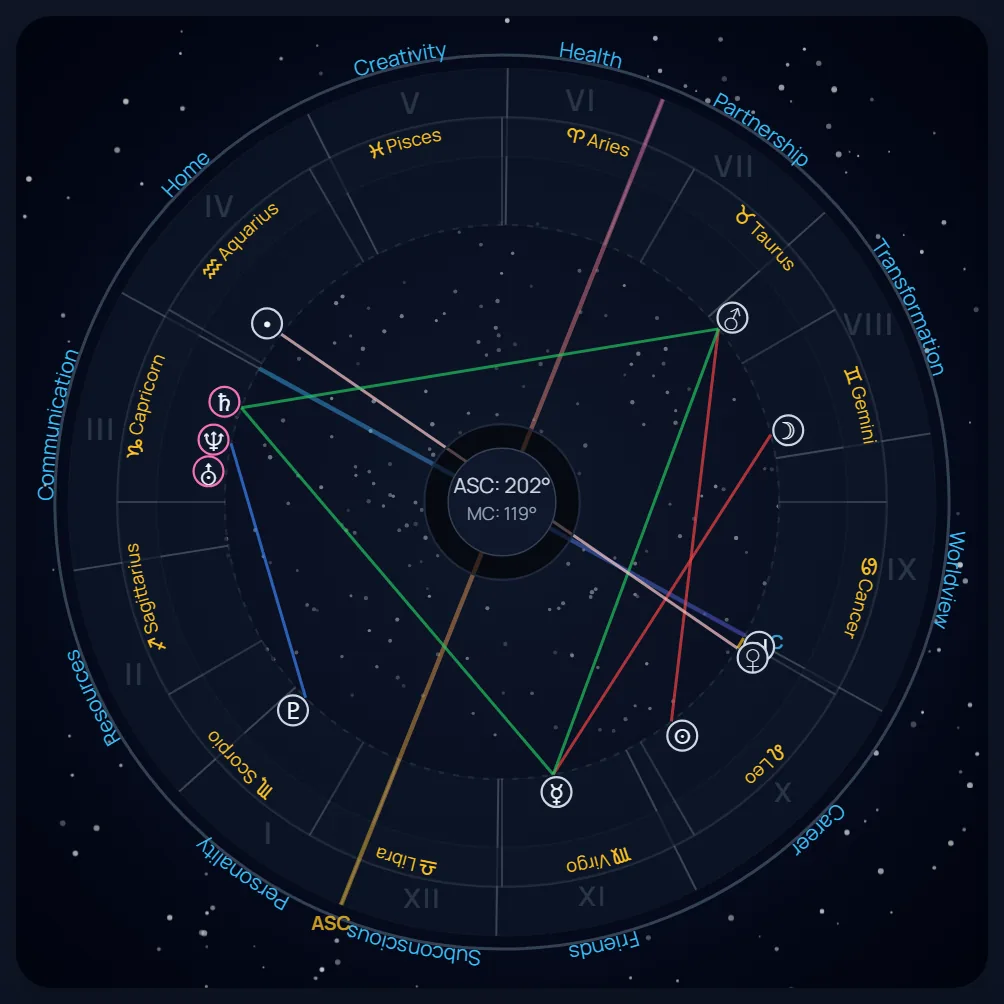
What to read first in a chart
For a beginner, this order works well:
- Sun sign: central style, motivation, and basic way of being
- Moon sign: emotional habits, comfort needs, and instinctive reactions
- Ascendant or rising sign: how a person tends to meet the world, including first impression and approach
- House placement of the Sun and Moon: where those themes often show up in life
- Major aspects to the Sun, Moon, and Ascendant ruler: what supports, sharpens, or complicates the baseline
This order keeps the reading grounded. It also answers the beginner question behind most searches: what changes the interpretation beyond Sun sign astrology? The short answer is context. The Sun describes one important layer. The Moon and rising sign often change the tone dramatically, and houses and aspects refine it further.
For a direct comparison, see Natal Chart Reading vs Sun Sign Astrology: What Actually Changes.
Step 1: Read the Sun as the main drive, not the whole personality
The Sun is often treated like the whole chart because it is the most familiar placement. In practice, it works better as the chart's central drive or organizing principle.
Ask questions like:
- What seems to motivate action?
- How does the person prefer to express confidence or purpose?
- What style of effort feels natural?
Keep the reading plain. If the Sun suggests a direct and assertive style, say that. If it suggests a measured and steady style, say that. Avoid turning the Sun sign into a full personality verdict.
Example of plain-language Sun reading
A Sun placement might suggest someone prefers to act openly, make decisions quickly, and feel momentum. Another Sun placement might suggest someone prefers consistency, tangible results, and a slower but more durable pace.
That is already more useful than a pile of adjectives because it points to behavior.
Step 2: Read the Moon as the inner response pattern
The Moon adds the emotional operating style. This is where a reading often stops sounding generic.
Ask:
- What helps a person settle after stress?
- How quickly do feelings show on the surface?
- Is the response style more private, verbal, practical, intense, or changeable?
The Moon often explains why two people with the same Sun sign can behave very differently. One may process feelings quickly and visibly. Another may go quiet, analyze, or seek control before responding.
Example of plain-language Moon reading
A Moon placement may point to someone who needs conversation and mental movement to process emotion. Another may point to someone who needs routine, reassurance, or time alone before speaking.
That difference matters in everyday life. It can shape how a person handles conflict, rest, pressure, and closeness.
Step 3: Read the rising sign as the approach to life
The Ascendant is the lens of entry. It often shows how a person starts things, how they come across at first, and what kind of style they use to meet unfamiliar situations.
This is not just “how others see you.” In a practical natal chart interpretation, the rising sign helps describe the person's approach pattern.
Ask:
- Does this chart meet life directly, cautiously, diplomatically, intensely, or experimentally?
- What is the default posture in new situations?
- Is the outer style aligned with the Sun, or does it contrast with it?
Example of plain-language rising reading
A rising sign may suggest a brisk, visible, fast-moving approach. Another may suggest a reserved, observant, selective approach. Neither is better. The point is to notice how the chart enters a room, a task, or a conversation.
Step 4: Put the big three together before adding more detail
This is where interpretation really begins.
Do not read the Sun, Moon, and rising sign as three separate mini-horoscopes. Read them as one sentence.
Try this formula:
- Sun = what drives the person
- Moon = what regulates the person
- Rising = how the person approaches life
Then combine them into a short plain-language summary.
Example synthesis
- A chart may show a strong need to act independently (Sun),
- paired with a need for emotional steadiness and predictability (Moon),
- expressed through a polished and socially aware outer style (Rising).
That creates a very different reading from simple “independent person” language. It suggests someone who may move decisively, but still care a lot about social tone and emotional stability.
Another chart might show:
- a strong need to think, discuss, and gather input (Sun),
- a private or intense emotional pattern (Moon),
- and a bold first approach (Rising).
That mix can describe a person who looks fearless at first contact but processes inner material much more deeply than others expect.
This is what makes a personal natal chart reading feel specific without becoming absolute.
Step 5: Use houses to locate where the main themes play out
Once the big three are clear, move to the houses of the Sun and Moon.
Houses answer a practical question: Where do these tendencies often become most visible?
For example, the Sun's sign may describe the style of self-expression, while the Sun's house shows the life area where that style is emphasized. The Moon's house can show where emotional investment, comfort-seeking, or reactivity tends to collect.
Keep the interpretation grounded:
- A house emphasis can suggest where attention goes repeatedly.
- It can point to recurring life arenas, not guaranteed events.
- It helps move from abstract personality language into lived context.
If the core placements are the "what," houses are often the "where."
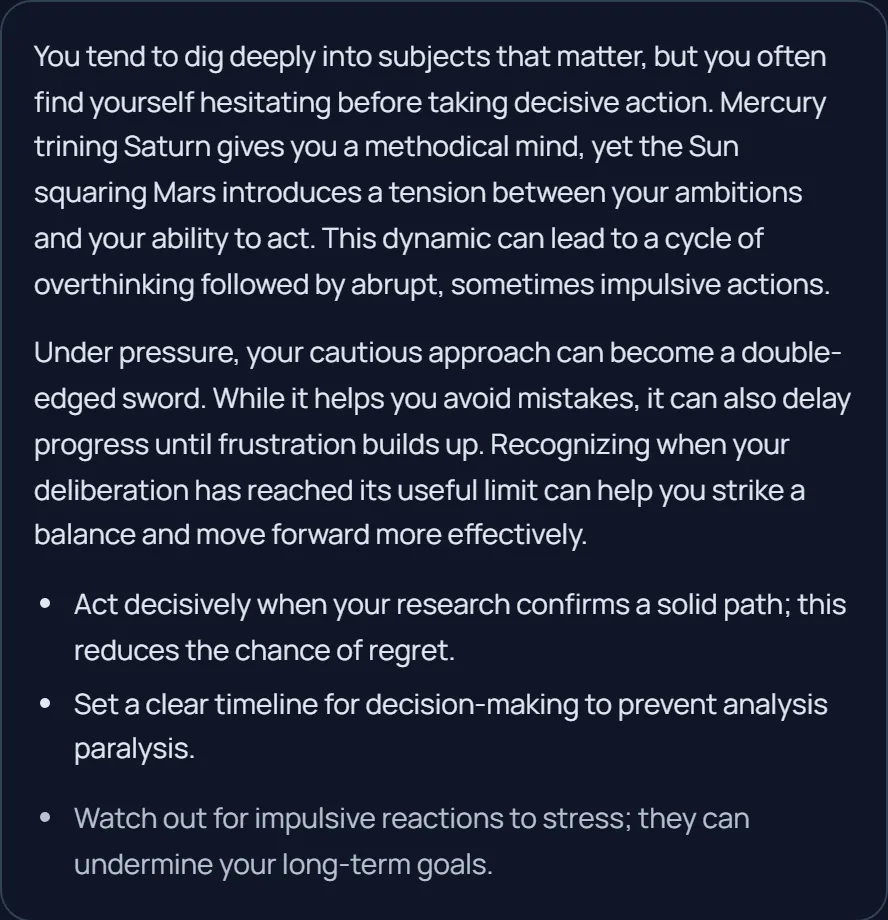
Step 6: Check major aspects for support or tension
Aspects show how chart factors relate to one another. For beginners, the most useful move is not reading every aspect. It is checking whether the Sun and Moon are reinforced, contradicted, or complicated by major connections.
Look for simple interpretive questions:
- Do the Sun and Moon work smoothly together, or is there internal friction?
- Does the chart show ease between self-expression and emotional needs?
- Is there tension between outer style and inner pace?
This is often the layer that turns a flat reading into a realistic one.
Example of aspect-based refinement
Suppose the big three suggest confidence, warmth, and outward ease. A tense major aspect to the Moon might add sensitivity under pressure, making the social ease real but not effortless. On the other hand, supportive aspects may show that the chart's main traits reinforce each other, creating a more consistent style.
Aspects do not cancel the core reading. They shape how smoothly it functions.
A simple template for reading a chart in plain language
Use this short structure when writing or thinking through a birth chart interpretation:
1. Core drive
What seems to energize identity and action?
2. Emotional pattern
What helps restore balance? What triggers withdrawal, reaction, or reassurance-seeking?
3. Approach style
How does the person tend to enter situations, relationships, and decisions?
4. Main tension or contrast
Where do the chart's parts pull in different directions?
5. Main reinforcement
Which traits repeat across multiple placements?
6. Life area emphasis
Where are these patterns most likely to become visible in ordinary life?
That framework is simple, but it keeps the reading interpretive instead of generic.
What beginners usually get wrong
Reading keywords instead of patterns
A sign description is only raw material. Interpretation means deciding how the traits combine and which ones matter most.
Treating one placement as the answer to everything
No single placement explains a whole person. Even the big three work best as a combined baseline, not isolated labels.
Mistaking abstraction for insight
Words like “intense,” “sensitive,” or “creative” are too vague on their own. Tie them to a behavior pattern. Does “intense” mean focused under pressure, guarded in closeness, or all-or-nothing in decision-making?
Overloading the reading too early
A beginner does not need every asteroid, fixed star, or minor aspect to get a solid interpretation. Read the chart's strongest signals first.
A short example: generic reading vs useful reading
Generic
“This chart shows independence, sensitivity, and strong intuition.”
That sounds polished, but it could fit a huge number of people.
More useful
“This chart suggests a strong need to make personal choices without too much interference, but emotional security still matters. The outer style may look self-directed and composed, while the inner response pattern is more changeable. In practice, that can create a push-pull between wanting freedom and wanting steadiness.”
The second version works better because it shows a dynamic. It gives the reader something observable.
When to go beyond the big three
The big three are enough for a baseline reading. Go further when you need to answer one of these questions:
- Where do these patterns show up most clearly? Use houses.
- Why does the chart feel internally mixed? Use major aspects.
- What style of communication, relating, or action stands out? Add Mercury, Venus, and Mars.
If you want a broader primer on reading order, Birth Chart Basics: What to Read First and How to Make Sense of It can help fill in the rest.
FAQ
What should a beginner read first in a natal chart?
Start with the Sun, Moon, and rising sign. Then check the houses of the Sun and Moon, followed by major aspects. That gives a strong first-pass interpretation without drowning in detail.
What makes an interpretation useful rather than generic?
Useful interpretation connects placements into one pattern, uses plain language, and ties symbolism to observable behavior. Generic interpretation lists traits without showing how they interact.
What changes the reading beyond Sun sign astrology?
The Moon, rising sign, houses, and aspects add context. They can change emotional tone, social style, and where chart themes become most visible.
Can the big three replace a full chart reading?
They can offer a solid baseline, but not a full picture. They are best used as the first layer. The rest of the chart explains emphasis, contrast, and complexity.
How long should a beginner spend on one chart?
Long enough to write a short summary in plain English. If the chart still reads like a list of placements, the interpretation is not finished yet.
Final takeaway
Strong natal chart interpretation is less about collecting meanings and more about reading structure. Start with the Sun, Moon, and rising sign. Combine them into one living pattern. Then use houses and aspects to sharpen the picture.
That method keeps a birth chart interpretation readable, specific, and actually useful.