A natal chart makes more sense when it is read in layers, not all at once. Beginners often get stuck because they try to decode every symbol on the page equally. That usually leads to a pile of disconnected meanings.
A better approach is simple: start with the parts that set the basic tone, then move outward. Read the chart like a structure. First identity, then emotional pattern, then outward style, then the life areas where those patterns show up.
Start with the Big Three
If a beginner asks what to read first in a natal chart, the best answer is the Big Three: Sun, Moon, and Rising sign.
These three placements create the fastest usable snapshot.
- Sun sign: core drive, basic style of will, what feels important to become or express
- Moon sign: emotional habits, instinctive reactions, what creates comfort or pressure
- Rising sign: outward approach, first impression, how a person meets situations and enters new environments
Read them as different jobs, not three versions of the same trait.
A Sun sign can show what someone is trying to do. A Moon sign can show what they need in order to feel steady while doing it. A Rising sign can show how they actually come across when action begins.
That difference is the first thing that changes interpretation beyond Sun sign astrology. Sun sign alone describes only one part of the picture. The Moon and Rising often explain why someone does not act like a flat stereotype of their Sun sign.
A quick practice example
Take this simple combination:
- Sun in Aries
- Moon in Cancer
- Rising in Libra
Even without the full chart, this is already more specific than "Aries means bold."
A practical reading could look like this:
- Sun in Aries points to direct effort, initiative, and a need to move rather than wait.
- Moon in Cancer adds emotional caution, strong sensitivity to atmosphere, and a tendency to protect what feels personal.
- Libra Rising softens the entry style. The person may approach others with charm, tact, or visible social awareness before the Aries directness appears.
That is a usable interpretation because each part has a separate role.
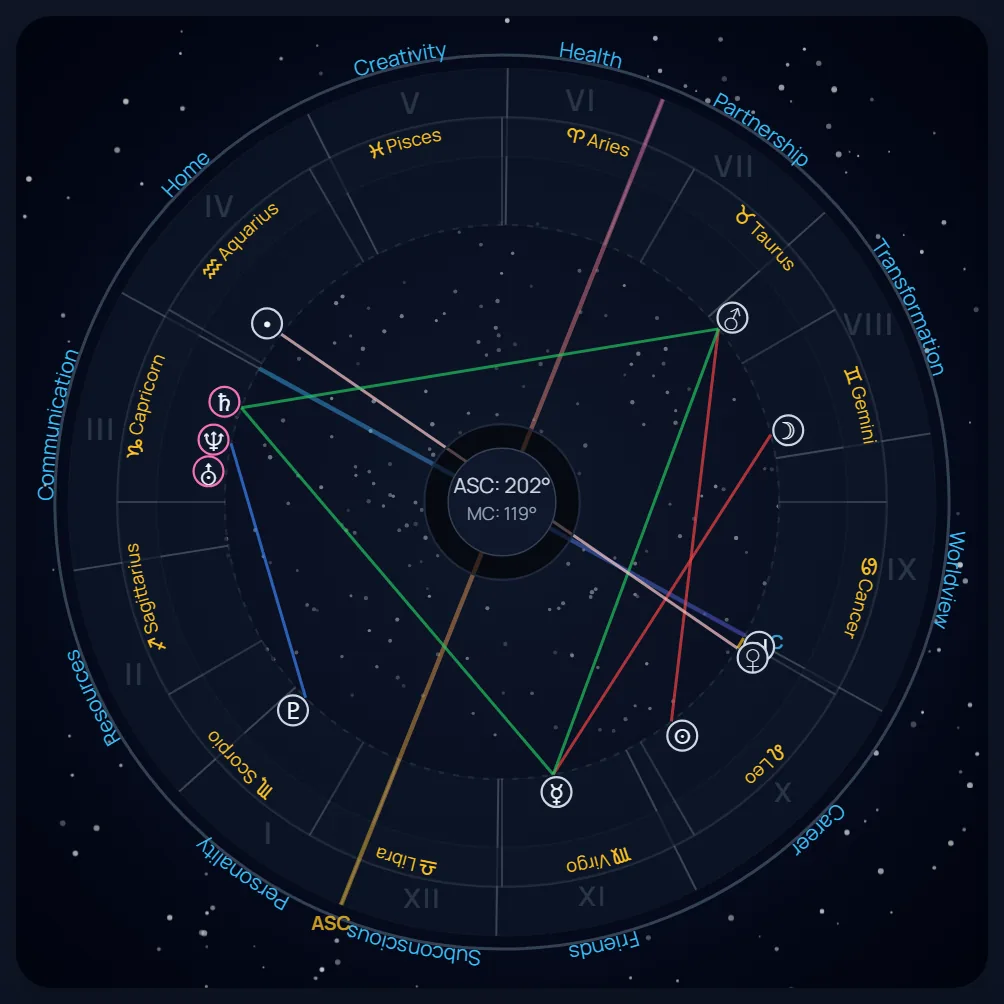
Read signs as style, not as a final answer
A sign describes how a planet tends to operate. It does not answer where that energy shows up most clearly or how strongly it interacts with the rest of the chart.
This is where many beginner readings go off track. They stop at sign meanings and treat the reading as complete.
For example:
- Mars in Virgo is not just "organized action"
- Venus in Gemini is not just "playful in love"
- Saturn in Pisces is not just "soft boundaries"
Those phrases are too thin to be useful. A real reading asks two more questions:
- Which life area does this placement land in?
- What other placements support it, block it, or complicate it?
That means signs come first, but they should never work alone.
Next, check the houses to see where the pattern lives
After the Big Three, move to the houses. Houses show the life areas where a placement tends to play out most directly.
If signs are style, houses are setting.
A few concrete examples:
- Sun in the 10th house often points toward visibility, ambition, public role, or pressure around achievement.
- Moon in the 4th house often emphasizes home, family patterns, privacy, and emotional roots.
- Mercury in the 3rd house can make communication, learning, errands, local networks, or daily information flow especially active.
This is one of the biggest differences between a general Sun sign reading and a natal chart reading. Two people can share the same Sun sign, but if one has the Sun in the 1st house and another has it in the 12th, the expression can feel very different in daily life.
A practical reading sequence for houses
When checking houses, use this order:
- Find the house of the Sun.
- Find the house of the Moon.
- Find the house of the chart ruler.
- Check whether several planets cluster in one house.
That gives a quick map of emphasis.
Why the chart ruler matters
The chart ruler is the planet that rules the Rising sign. It adds direction to the whole chart.
For example:
- Aries Rising -> ruled by Mars
- Taurus Rising -> ruled by Venus
- Gemini Rising -> ruled by Mercury
If the Rising sign shows the approach to life, the chart ruler shows where that approach gets pulled and what it depends on.
Example:
- Capricorn Rising with Saturn in the 6th house may put strong focus on work systems, duty, health routines, and performance standards.
- Capricorn Rising with Saturn in the 11th house may shift that same serious style toward group roles, networks, social responsibility, or long-term goals.
Same Rising sign. Different center of gravity.
Then read aspects to understand tension and flow
Once the signs and houses are clear, move to aspects. Aspects show how placements relate to each other.
This is where the chart starts to act like a system instead of a list.
The main beginner aspects to learn first are:
- Conjunction: two placements fused together
- Sextile: easy opportunity, support with some effort required
- Square: friction, pressure, competing needs
- Trine: natural flow, skill, ease that may become automatic
- Opposition: pull between two poles, often needing balance
Why aspects matter in real interpretation
Without aspects, a beginner may read placements one by one and miss the main story.
Example:
- Mercury in Capricorn can suggest careful, structured thinking.
- If Mercury squares Uranus, that steady style may be interrupted by sudden ideas, impatience with rigid logic, or bursts of contrarian thinking.
Both meanings are true, but the aspect changes the behavior pattern.
Another example:
- Moon in Taurus may seek stability and routine.
- If that Moon opposes Pluto, emotional steadiness may exist alongside intensity, control issues, or strong reactions when trust is threatened.
The sign gives baseline style. The aspect shows what complicates it.
Build a core snapshot before reading everything else
Beginners do better with a short summary than with total chart coverage. After reviewing the Big Three, houses, and major aspects, write a core snapshot in plain language.
A strong snapshot usually answers four questions:
- What drives action?
- What creates emotional steadiness or stress?
- How does the person meet the world?
- Which life areas carry the most weight?
Here is a sample template:
- Core drive: shown by the Sun sign, house, and major aspects
- Emotional baseline: shown by the Moon sign, house, and major aspects
- Social or outward style: shown by the Rising sign and chart ruler
- Main life emphasis: shown by house clusters, angular houses, and repeated themes
This is enough to produce a reading that feels grounded instead of scattered.
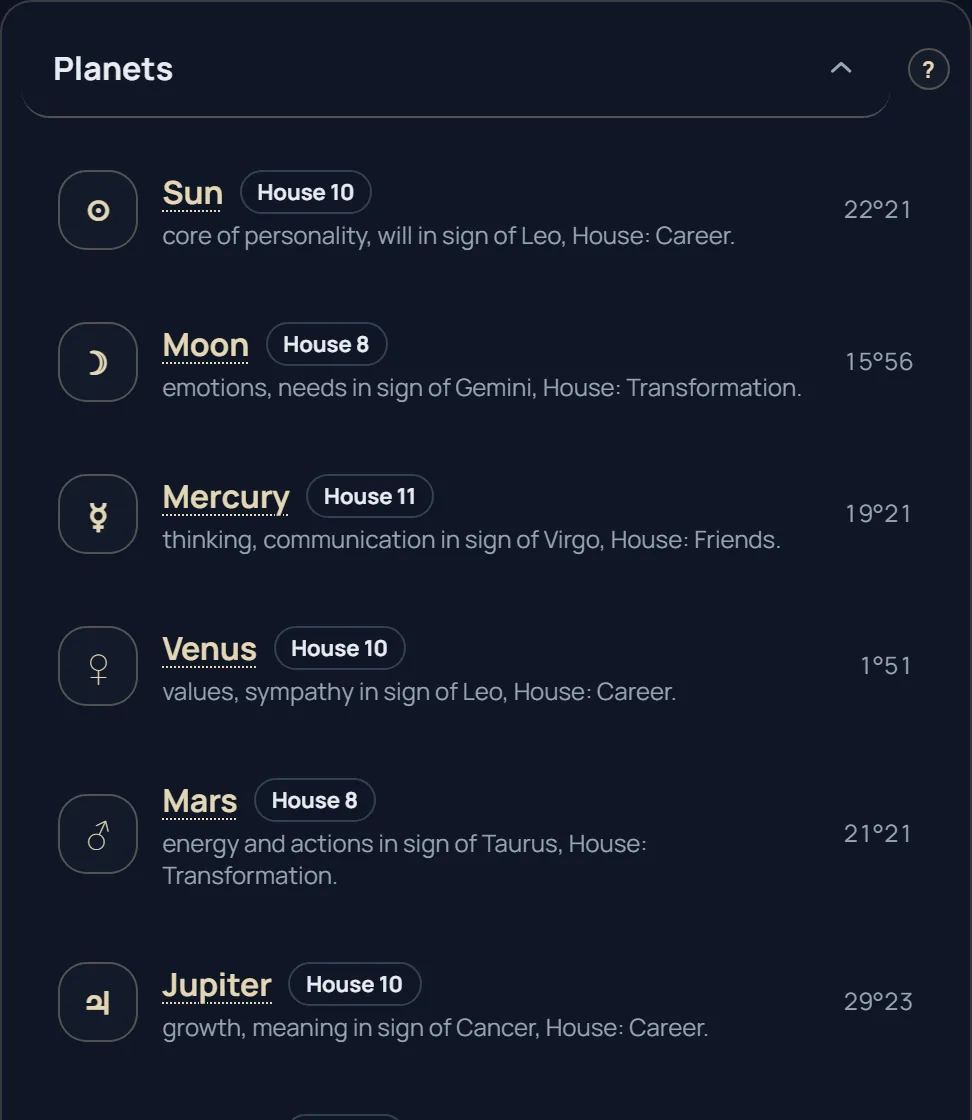
Look for repeated themes, not isolated traits
A natal chart becomes clearer when the same message appears more than once.
Repeated themes matter more than single placements.
For example, a theme of initiative may appear through:
- fire sign emphasis
- Mars strongly placed
- planets in the 1st house
- aspects that push action or competition
A theme of caution may appear through:
- earth sign emphasis
- Saturn touching personal planets
- heavy 6th or 10th house focus
- squares that create self-monitoring or restraint
When several chart factors point in the same direction, the interpretation becomes more reliable. That is more useful than pulling one dramatic meaning from one planet.
Use life themes to keep the reading practical
A good beginner reading does not try to explain every possible trait. It identifies a few life themes that show up across the chart.
Useful life themes include:
- identity and self-direction
- emotional regulation under pressure
- communication style
- work habits and responsibility
- relationships and boundaries
- visibility, ambition, and public role
- home base and private needs
For each theme, tie the reading to behavior.
Instead of saying "strong relationship energy," say:
- decision-making may be shaped by other people’s responses
- cooperation may come naturally, but direct conflict may take extra work
- partnership may become a major setting for growth or friction
That kind of language helps a beginner understand what a chart factor does in practice.
A simple step-by-step reading order for beginners
Use this sequence every time:
- Note the Sun, Moon, and Rising signs.
- Read each one by role: drive, emotion, outward approach.
- Find the houses of the Sun and Moon.
- Identify the chart ruler and its house.
- Check for house clusters or standout angular placements.
- Review major aspects involving the Sun, Moon, Rising ruler, Mercury, Venus, and Mars.
- Look for repeated themes across signs, houses, and aspects.
- Write a short core snapshot in plain English.
This reading order prevents overload. It also keeps the interpretation connected to actual life patterns instead of random keywords.
Common beginner mistakes to avoid
Reading only the Sun sign
This is the most obvious problem. Sun sign astrology gives a narrow slice. The Moon, Rising, houses, and aspects often explain the part that feels missing.
Treating every placement as equally important
Not every symbol carries the same weight in a first reading. Start with the Big Three, chart ruler, and major aspects before moving to minor details.
Using sign meanings without context
A sign meaning is only one layer. Always ask where the placement sits and what it connects to.
Forcing the chart into one personality label
A chart often shows mixed motives. Someone can be direct and cautious, social and private, ambitious and conflict-avoidant. The point is to read the pattern, not flatten it.
FAQ
What should a beginner read first in a natal chart?
Start with the Sun, Moon, and Rising sign. Then check the houses of the Sun and Moon, followed by the chart ruler and major aspects. That gives the clearest first snapshot.
What changes the interpretation beyond Sun sign astrology?
The biggest changes come from the Moon, Rising sign, houses, and aspects. These show emotional pattern, outward style, life areas of focus, and internal tension or support between placements.
Is the Big Three enough for a basic reading?
For a baseline snapshot, yes. The Big Three can show core drive, emotional habits, and outward style. For a more accurate reading, add houses and major aspects.
Why do two people with the same Sun sign seem so different?
Because the Sun is only one part of the chart. Different Moon signs, Rising signs, house placements, and aspects can produce very different behavior patterns.
Do houses or aspects matter more for beginners?
Both matter, but houses are often easier to grasp first. They answer where the energy shows up. Aspects are the next step because they explain how different parts of the chart work together or clash.
Final takeaway
The cleanest way to learn natal interpretation is to stop chasing every symbol at once. Read the chart in order. Start with the Big Three. Add houses to locate the action. Add aspects to understand tension and flow. Then look for repeated themes.
That is how birth chart basics turn into a readable system instead of a page full of disconnected terms.