A birth chart makes more sense when it is read in layers, not all at once.
Most beginners get stuck for the same reason: they try to interpret every symbol on the wheel before they know which parts carry the most weight. A cleaner approach is to start with the chart's basic structure, then move from core identity markers to the details that modify them.
That order matters. It helps answer the question behind most beginner searches: what should be read first, and what actually changes the meaning beyond a Sun sign?
Start with the chart as a map
A birth chart is a snapshot of where the planets appeared from Earth at the moment of birth. In practice, a reading comes from four main pieces working together:
- Planets show functions or drives
- Signs show style or tone
- Houses show life areas
- Aspects show how parts of the chart interact
A quick way to remember it:
- Planet = what
- Sign = how
- House = where
- Aspect = how the parts relate
If that sounds abstract, make it concrete. Think of Mars:
- Mars is action, effort, and how energy gets used
- Mars in Gemini may suggest a quicker, more verbal, more changeable style of action
- Mars in the 10th house points that action toward public life, work, reputation, or visible goals
- Mars aspect Saturn may add restraint, discipline, delay, or friction around effort
The meaning does not come from one symbol alone. It comes from combination.
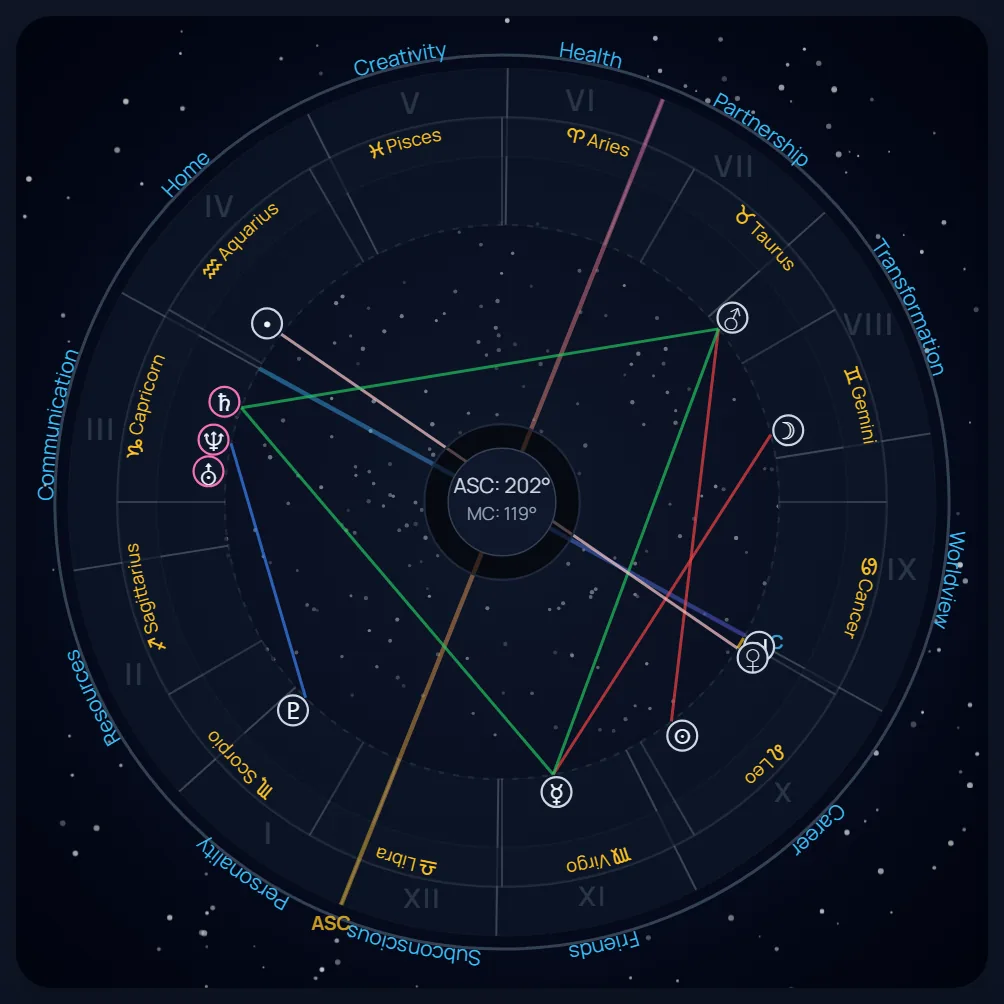
Read in this order if you are a beginner
A practical reading order looks like this:
- Check the Big Three: Sun, Moon, and Rising
- Look at the chart ruler if you know the Rising sign
- Scan where the personal planets fall by sign and house
- Notice which houses are emphasized
- Read the major aspects
- Step back and summarize the repeating themes
This keeps the chart readable. It also stops a common beginner mistake: giving one placement too much importance.
Step 1: Read the Big Three first
The Big Three give the fastest usable snapshot of a chart.
Sun: core style and conscious direction
The Sun is often treated as identity, but for reading purposes it helps to think of it more simply: the Sun shows a central style of being and a basic way of expressing purpose.
Questions to ask:
- What sign is the Sun in?
- What house is the Sun in?
- Is the Sun strongly aspected?
A Sun in a fire sign may present drive in a direct or expressive way. A Sun in an earth sign may show a more practical, steady style. The house tells where that solar focus tends to show up most clearly.
Example reading use case:
- Sun in Virgo in the 3rd house can point toward a careful, analytical style expressed through learning, speaking, organizing information, or daily communication.
That is already more specific than Sun sign astrology alone because the house changes the context.
Moon: habits, needs, and emotional rhythm
The Moon is useful for reading everyday responses. It can offer a reflection framework for needs, comfort patterns, and how a person tends to process experience.
Questions to ask:
- What settles the Moon?
- What sign style does it use under pressure?
- Which house shows where those needs become most visible?
Example:
- Moon in Cancer in the 6th house may suggest that routine, usefulness, and familiar habits matter strongly for feeling settled.
That does not mean one fixed trait. It gives a pattern to look at: when life gets busy, does emotional balance depend on order, care, and repeatable habits?
Rising sign: approach, pacing, and first impression
The Rising sign, or Ascendant, is one of the most practical starting points because it affects how the chart is organized. It can describe the way someone meets new situations, moves through life, and gets read at first glance.
It also sets the house structure, which is why it matters so much in step-by-step chart reading.
Example:
- Capricorn Rising may suggest a measured, controlled, deliberate approach to new environments.
- If the Sun is in Sagittarius, the outward pace may look more contained than the core style alone would suggest.
That contrast is exactly why Sun-only astrology misses so much.
For a simpler baseline read of these three placements, see How to Read a Natal Chart: A Beginner’s Guide to the Big Three and Beyond.
Step 2: Find the chart ruler
Once the Rising sign is known, find its planetary ruler. That planet acts like a guide to the chart's overall style.
A few examples:
- Aries Rising -> Mars rules the chart
- Taurus Rising -> Venus rules the chart
- Gemini Rising -> Mercury rules the chart
- Cancer Rising -> Moon rules the chart
Then ask:
- What sign is the ruler in?
- What house is it in?
- What aspects does it make?
Why this matters: the chart ruler often shows where a lot of personal energy gets routed.
Example:
- Libra Rising with Venus in the 10th house may push relationship, taste, diplomacy, or aesthetic judgment into work and public presentation.
Even before reading the whole wheel, the chart starts to gain shape.
Step 3: Read the personal planets next
After the Big Three, move to Mercury, Venus, and Mars. These placements are easier to use in daily life than jumping straight into every outer planet.
Mercury: thinking and communication
Mercury helps with questions like:
- How is information processed?
- How is speech delivered?
- How are decisions approached?
Example:
- Mercury in Aries may communicate quickly and directly.
- Mercury in Pisces may process in a more associative or intuitive way.
- Mercury in the 9th house may focus on bigger frameworks, study, teaching, or worldview questions.
Venus: taste, relating style, and preference
Venus is not just romance. It is also about preference, social style, and what feels pleasant, balanced, or worth keeping.
Useful reading questions:
- What kind of exchange feels easy?
- What social tone comes naturally?
- What does this placement value in daily choices?
Mars: effort, friction, and action style
Mars shows how energy gets used, how pressure is handled, and how someone pushes forward.
Useful reading questions:
- Is action fast or measured?
- Is conflict met directly or indirectly?
- Where does initiative show up most clearly?
Together, Mercury, Venus, and Mars turn a chart from broad personality language into behavior patterns you can actually picture.
Step 4: Use the houses to locate life themes
Signs describe style. Houses show where that style tends to play out.
This is where beginner readings usually become more grounded.
A few practical house examples:
- 1st house: approach, presentation, immediate style
- 3rd house: communication, learning, local environment, everyday exchange
- 4th house: home base, roots, private life
- 6th house: routines, work habits, maintenance, daily systems
- 7th house: one-to-one dynamics, partnership patterns
- 10th house: public role, visibility, long-term direction
If several planets gather in one house, that life area often becomes a major focus.
Example:
- A chart with multiple placements in the 6th house may keep returning to routine, workload, skill-building, maintenance, or useful structure.
- A chart with emphasis in the 11th house may lean more toward networks, groups, collaboration, and future plans.
This is one of the clearest answers to the question of life themes. You do not need to force a grand destiny statement. Look for repeated emphasis instead.
Step 5: Read aspects after the main placements
Aspects show how chart parts support, challenge, or complicate each other. Beginners often rush to aspects too early. Read them after the core placements so you know what is being modified.
Focus on the major aspects first:
- Conjunction: energies merge
- Sextile: easier flow, often requiring some action to use well
- Square: tension, friction, pressure to develop
- Trine: natural ease or familiarity
- Opposition: pull between two ends that need balancing
How aspects change interpretation
Take this example:
- Mercury in Taurus might suggest a steady, deliberate thinking style.
- If Mercury squares Mars, communication may become sharper, more reactive, or more argumentative under pressure.
- If Mercury trines Saturn, the same Mercury may express with greater structure, patience, and precision.
The planet placement gives the base meaning. The aspect shows how smoothly that function operates.
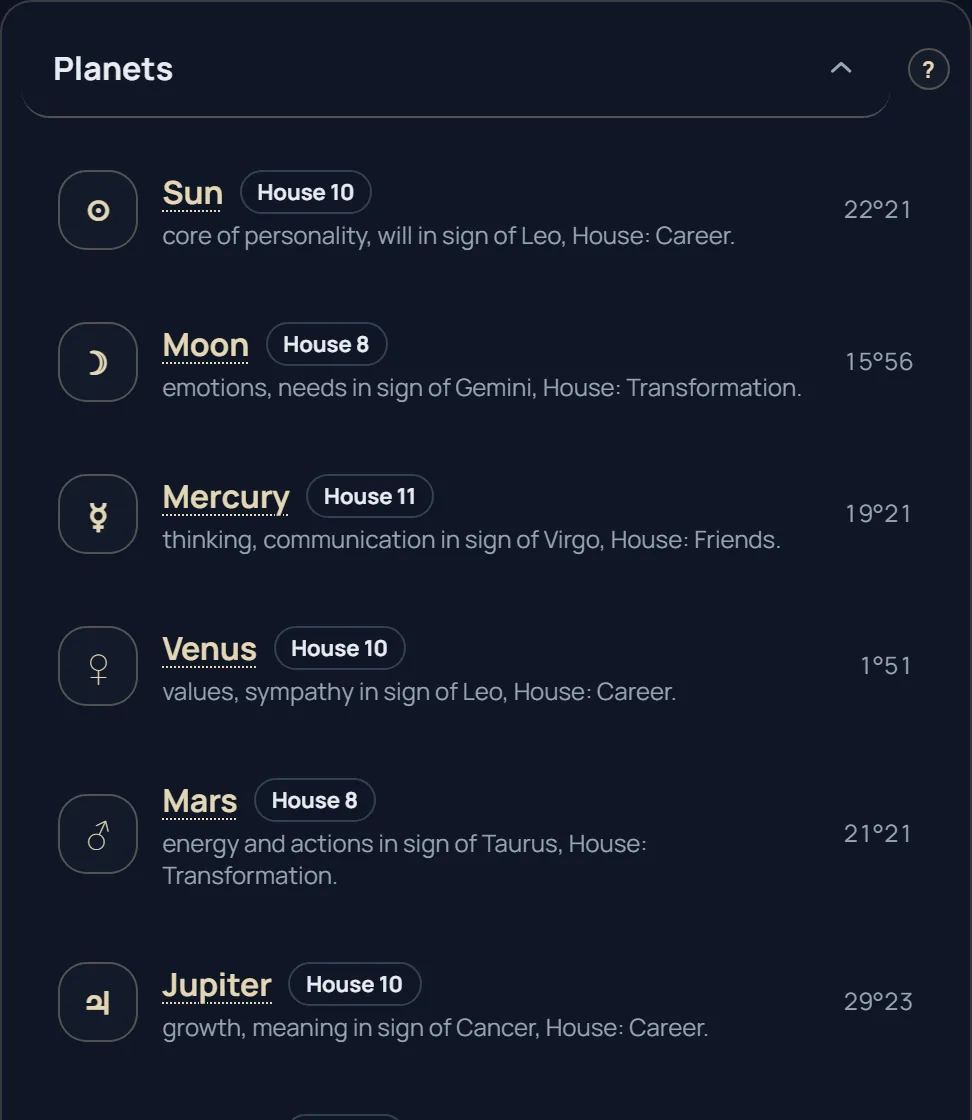
Step 6: Look for repetition, not isolated symbols
A useful natal reading comes from patterns that repeat across the chart.
Look for:
- The same element showing up often
- The same mode repeating
- Several planets pointing to one house theme
- A chart ruler reinforcing what the Big Three already suggest
- Aspects that intensify one topic again and again
Example of pattern reading:
- Earth emphasis
- Strong 6th and 10th house activity
- Saturn linked to personal planets
Taken together, that may point toward a chart where structure, effort, reliability, and practical output are major organizing themes.
That is stronger than saying one placement means one trait. A good reading weighs repetition more than novelty.
A simple birth chart reading example
Here is a stripped-down example of the full method:
- Sun in Leo in the 11th house
- Moon in Taurus in the 8th house
- Virgo Rising
- Mercury in Cancer in the 10th house
- Venus in Gemini in the 10th house
- Mars in Libra in the 2nd house
- Sun square Moon
How to read it step by step:
-
Big Three
- Sun in Leo suggests a warm, expressive core style
- Moon in Taurus suggests steadier emotional pacing and a need for stability
- Virgo Rising adds a more measured, observant outward approach
-
Chart ruler
- Virgo Rising makes Mercury the chart ruler
- Mercury in the 10th house points attention toward public communication, reputation, or visible work
-
Personal planets
- Venus in Gemini adds variety and verbal ease in social and creative style
- Mars in Libra may prefer strategic action over blunt force, especially around values or resources if placed in the 2nd house
-
House emphasis
- The 10th and 11th houses suggest strong themes around public contribution, group settings, audience, or networked work
-
Aspects
- Sun square Moon adds tension between conscious aims and comfort needs. In practice, this can show up as friction between self-expression and emotional steadiness.
-
Summary
- The chart may center on visible contribution and connection with others, but with a built-in need to balance recognition, comfort, and practical pacing.
This kind of reading is useful because it stays concrete. It does not claim certainty. It shows how meanings build.
What changes the reading beyond Sun sign astrology?
Three things change the picture fastest:
1. The Rising sign changes the frame
The Rising sign shapes first approach and sets the house layout. Two people with the same Sun sign can read very differently once the Rising sign changes.
2. The Moon changes the inner rhythm
Sun sign descriptions often miss what a person needs to feel steady, how they react under stress, or what patterns they fall back on.
3. Houses and aspects add context
A planet in a sign is not enough. The house shows where it lands in life. The aspects show whether it works easily, tensely, or with complexity.
If you want the direct comparison, read Natal Chart Reading vs Sun Sign Astrology: What Actually Changes.
Common beginner mistakes
Reading every placement as equally important
The Big Three, chart ruler, personal planets, and repeated house themes usually matter more than a random minor detail.
Ignoring the house position
A planet without its house is only half-read.
Treating one aspect as the whole story
A square can matter a lot, but it does not cancel the rest of the chart.
Forcing fixed meanings
Astrology works better as a pattern language than a rigid label system. The same placement can show up differently depending on context, emphasis, and overall chart structure.
Skipping the summary step
A reading should end with a handful of themes, not a pile of disconnected notes.
For another beginner-friendly framework, see Birth Chart Basics: What to Read First and How to Make Sense of It.
A quick checklist for understanding a birth chart
Use this when reading any chart from scratch:
- Note the Sun, Moon, and Rising
- Find the chart ruler
- Read Mercury, Venus, and Mars by sign and house
- Mark any house emphasis
- Check the major aspects
- Look for repeated themes
- Write a 3-5 sentence summary in plain language
That final summary is where the reading becomes useful.
FAQ
In what order should planets, houses, and aspects be read?
Start with the Big Three, then the chart ruler, then personal planets by sign and house. After that, look for house emphasis and read the major aspects. Save the final interpretation for the end, once patterns repeat.
What should a beginner read first in a natal chart?
Read the Sun, Moon, and Rising sign first. They give the quickest framework for core style, emotional rhythm, and overall approach.
What matters more: planets, houses, or aspects?
None works well alone. Planets show the function, houses show the life area, and aspects show how easily or tensely that function operates. For beginners, planets and houses usually come first, with aspects used to refine the reading.
How do I know which life themes stand out?
Look for repetition. Several planets in one house, a strong chart ruler placement, or multiple aspects pointing to the same topic usually matter more than a single isolated symbol.
Can a birth chart be read without predicting anything?
Yes. A chart can be used as a reflective framework for noticing style, habits, pressures, and recurring themes. That is often the most practical way to read it, especially for beginners.