A free birth chart and a full interpretation are not the same product in different packaging. They answer different questions.
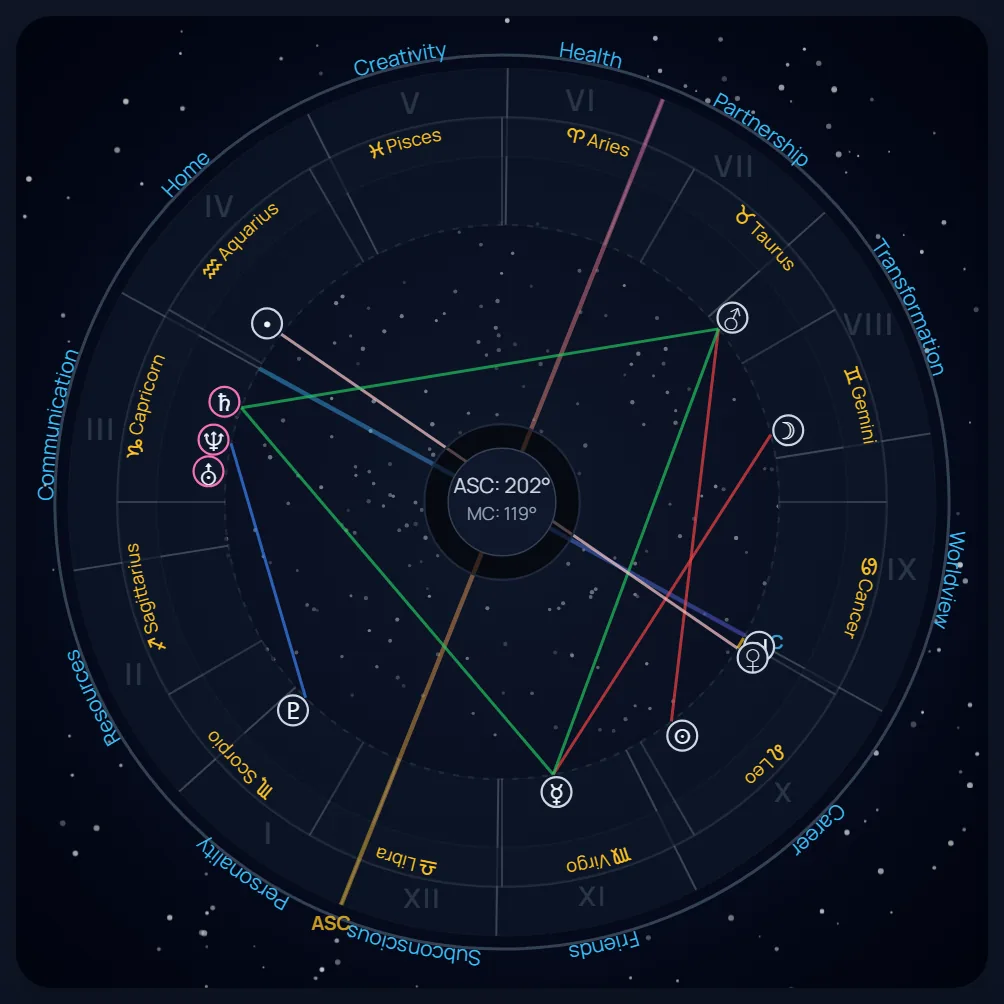
A free chart usually shows where the planets were placed at birth. That is useful. It gives the raw layout: signs, houses, and often a list of aspects. But it does not always explain which placements matter most, which ones modify each other, or why two seemingly opposite traits can both show up in one chart.
A full birth chart interpretation tries to do the harder job: turning the layout into a reading framework. That means sorting signal from noise, connecting the big three to the rest of the chart, and showing how life themes are shaped by combinations rather than single labels.
For beginners, that difference is where most confusion starts.
What a free birth chart usually provides
Most free astrology chart tools are built to answer one immediate question: what is in the chart?
That usually includes:
- Sun, Moon, and Rising sign
- Planetary signs
- House placements
- Major aspects
- A wheel chart or table
Some free charts add short keyword descriptions. Those can be helpful for orientation, but they are often fragmented. One line might describe the Sun as direct and steady, another might describe the Moon as private and changeable, and a third might describe the Rising sign as sociable or guarded. None of that is wrong. It is just incomplete.
A free chart is strongest when you use it as a reference map. It tells you what to look at. It usually does not tell you what to prioritize.
If the technical side still feels fuzzy, this guide on the mechanics of chart generation can help: Birth Chart Calculator Explained: What It Uses and How to Read the Result
What a full interpretation adds
A full interpretation answers the next question: how do these parts work together?
That extra layer usually includes:
- A sense of hierarchy: which placements carry the most weight
- Connections between Sun, Moon, and Rising rather than separate blurbs
- Tension points, support patterns, and repeated themes
- A clearer read on style, motivation, habits, and blind spots
- Practical context for houses and aspects
This is the difference between seeing a list of ingredients and understanding the recipe.
For example, a free chart may show:
- a Sun sign that points to a basic drive
- a Moon sign that points to emotional habits
- a Rising sign that suggests outward style
A full interpretation asks better questions:
- Do those three support each other or pull in different directions?
- Does the chart repeat one element or modality enough to shape overall style?
- Do house placements shift where the big three are most visible in daily life?
- Do major aspects sharpen, soften, or complicate the basic sign meanings?
That is where natal chart reading stops being a pile of labels and starts becoming readable.
Free chart vs full interpretation: the clearest practical difference
The simplest comparison is this:
A free chart tells you what is there
It gives the structure.
A full interpretation tells you what changes because it is there together
It gives the pattern.
That sounds small, but in practice it changes everything.
A beginner looking only at a free chart might read ten separate descriptions and come away with a vague conclusion like, “I guess this chart is a mix of confident, sensitive, serious, social, and independent.” That does not help much because most charts contain variety.
A stronger interpretation narrows the picture. It may show that the chart’s core pattern is not random variety but a recurring tension between visibility and privacy, or between planning and spontaneity, or between personal comfort and public ambition. That kind of synthesis is what people are usually looking for when they ask for insight.
Why people confuse the big three with a full chart
The big three are often presented as a shortcut, and to a point, they are.
- Sun: basic identity style or central drive
- Moon: emotional pattern and instinctive response
- Rising: outward approach, first impression, and how a person enters situations
That trio gives a solid baseline. It is often the best place to start because it captures personality from three different angles instead of reducing everything to the Sun sign.
But the big three are still a summary, not a full reading.
People confuse them with the whole chart because they already feel more specific than Sun sign astrology. And they are more specific. But they still leave out major context:
- where those placements fall by house
- whether they are strongly aspected
- which planets are emphasized elsewhere
- whether the chart has repeated themes that outweigh one sign description
If you want a beginner-friendly path, start with the big three, then expand outward. This piece offers a clear baseline approach: Birth Chart Logic: Big Three vs Full Chart and What Actually Changes
What changes beyond Sun sign astrology
The biggest shift is that interpretation becomes structural instead of generic.
Sun sign astrology isolates one placement. Natal chart reading compares multiple layers.
Here is what changes once you move beyond Sun sign astrology:
1. Contradictions start to make sense
A Sun sign description may sound bold and expressive, while the Moon suggests caution and privacy. A beginner often sees that as a problem. It is not. Full interpretation treats those as different functions, not a failed personality test.
In practice, that can describe someone who acts confident in work settings but needs a lot of quiet recovery afterward. One placement does not cancel the other.
2. Timing and context matter less than theme and placement
A generic sign description floats free of context. A natal reading grounds traits in life areas through houses and emphasis.
For example, communication style, home life, work habits, or public presentation may be highlighted differently depending on where key placements land. The point is not prediction. The point is relevance.
3. Repetition becomes more important than any one label
One sign or one planet can be interesting. Repeated patterns are usually more telling.
If several placements point toward the same style of decision-making, stress response, or social rhythm, that theme carries more weight than a single catchy description from a free chart.
4. The reading gets more usable
A list of traits is easy to skim and forget. A connected interpretation is easier to apply.
It may help a reader notice where friction tends to show up, what environments suit their style better, or why motivation looks different in private than it does in public.
What should a beginner read first in a natal chart?
Start narrow. Most people get lost because they try to read everything at once.
A practical reading order looks like this:
- The big three for a personality baseline
- Chart emphasis such as repeated elements, modalities, or standout placements
- House placements for life-area context
- Major aspects for tension, ease, and pattern linking
- Life themes that repeat across the chart
That order matters because it moves from simple to structured.
If you start with aspects before you understand the core personality snapshot, the chart can feel overly technical. If you stop at the big three, the reading can stay too broad.
For a cleaner first-pass method, see: Understanding a Birth Chart Step by Step: What to Read First
A concrete example: map vs interpretation
Imagine two different outputs from the same birth data.
Free chart output
- Sun in one sign
- Moon in another sign
- Rising in a third sign
- Mercury, Venus, and Mars listed by sign
- A wheel with houses and aspect lines
- Short keyword blurbs under each placement
Useful? Yes.
But a beginner still has to answer:
- Which three placements deserve the most attention?
- Why do some descriptions seem opposite?
- What does a house placement change?
- Which aspect matters and which one is minor noise?
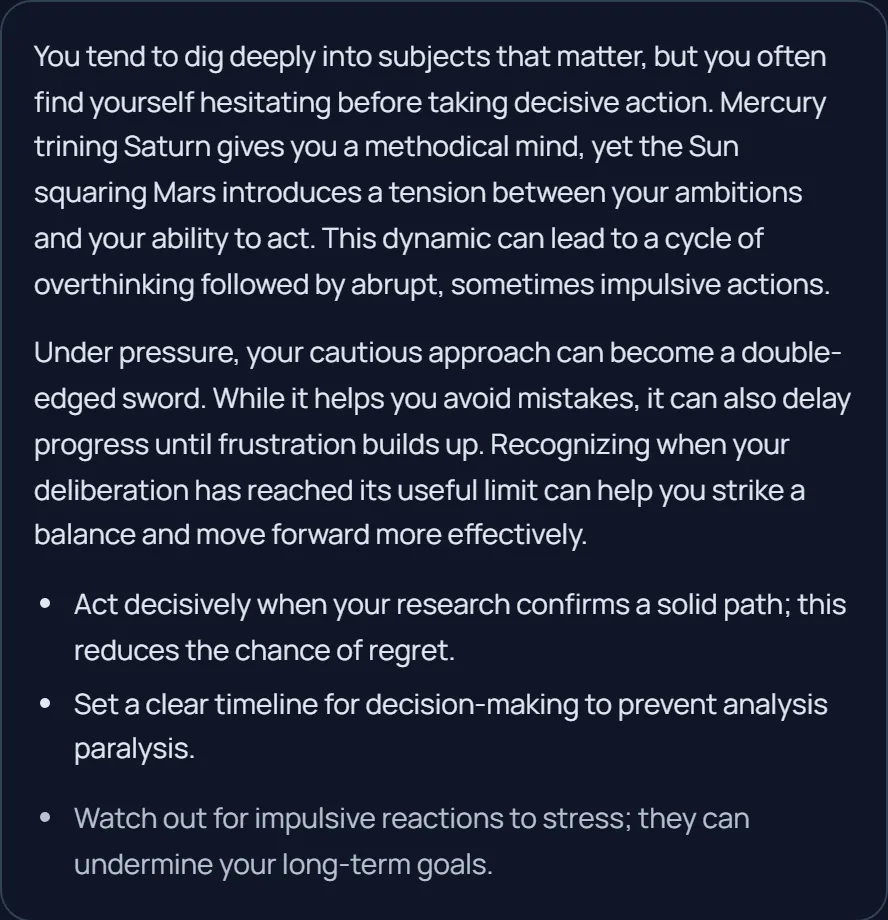
Full interpretation output
- The big three are explained as a working set
- Emotional needs are compared with public style
- House emphasis shows where effort and attention tend to collect
- Strong aspects explain inner friction or coherence
- Repeated themes are summarized in plain language
That second version does not add magic. It adds editing. It organizes the same chart into a reading that a beginner can actually use.
When a free chart is enough
A free birth chart is often enough when:
- you only want the placements
- you are learning chart structure piece by piece
- you want to confirm your big three
- you prefer doing your own reading from source material
It is also a good first step if you are still deciding whether astrology is useful to you as a reflective tool.
When a full interpretation is worth it
A fuller reading is more useful when:
- the chart feels contradictory
- the big three seem too vague on their own
- you want to understand house and aspect context
- you keep reading separate placement meanings without seeing the pattern
- you want one coherent beginner overview instead of ten disconnected snippets
The value is not that it tells you who you are with certainty. The value is that it helps organize the chart into clearer themes and tradeoffs.
Common beginner mistake: collecting meanings instead of reading patterns
The most common reading mistake is stacking descriptions one after another.
That approach produces too much information and not enough judgment. A chart is not read by collecting every possible meaning. It is read by noticing which meanings repeat, which placements dominate, and which combinations change the tone of the whole.
That is why free charts can feel both detailed and unsatisfying. They contain data, but not always interpretation.
FAQ
What does a free chart usually provide?
Usually the chart wheel, planetary placements by sign and house, and a list of aspects. Some tools also include short meanings for each placement, but these are often isolated rather than integrated.
What additional context comes from interpretation?
Interpretation connects placements into themes. It can show which parts of the chart are central, where contradictions are normal, and how houses and aspects change the plain sign meanings.
What should a beginner read first in a natal chart?
Start with the Sun, Moon, and Rising sign. Then look for repeated emphasis, house context, and only after that move into major aspects. That sequence keeps the chart readable.
What changes the reading beyond Sun sign astrology?
The main change is context. Instead of relying on one sign description, the reading compares multiple placements and asks how they interact. That usually produces a more specific and less generic picture.
Is a full interpretation always better?
Not always. If the goal is simply to get the chart data or learn the basics gradually, a free chart can be enough. A full interpretation helps most when the raw chart feels confusing or too fragmented to read on its own.
A free chart gives the framework. A full interpretation gives the logic. If the first feels interesting but thin, the second is what usually fills the gap.