A birth chart calculator is only as useful as your understanding of what it is actually calculating. Many beginners expect a personality summary. What the tool really does first is map positions: planets, signs, houses, and angles based on birth date, birth time, and birth location.
That distinction matters. The calculator creates the chart structure. The reading comes after.
If the result looks crowded or technical, use this simpler approach: first learn what the calculator changes, then read the chart in a fixed order. That keeps the chart from turning into a wall of symbols.
What a birth chart calculator calculates
A birth chart calculator uses three core inputs:
- Birth date
- Birth time
- Birth location
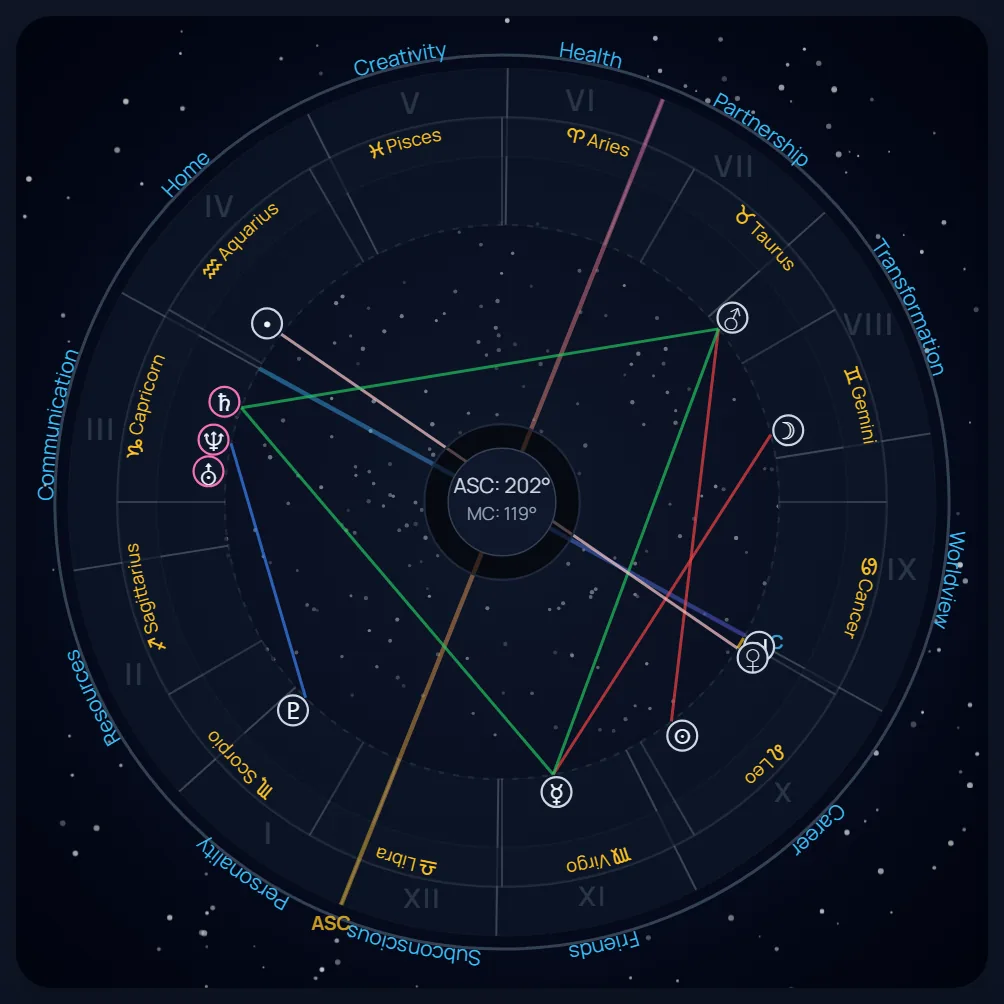
From those inputs, it calculates a chart snapshot for the moment and place of birth. That snapshot usually includes:
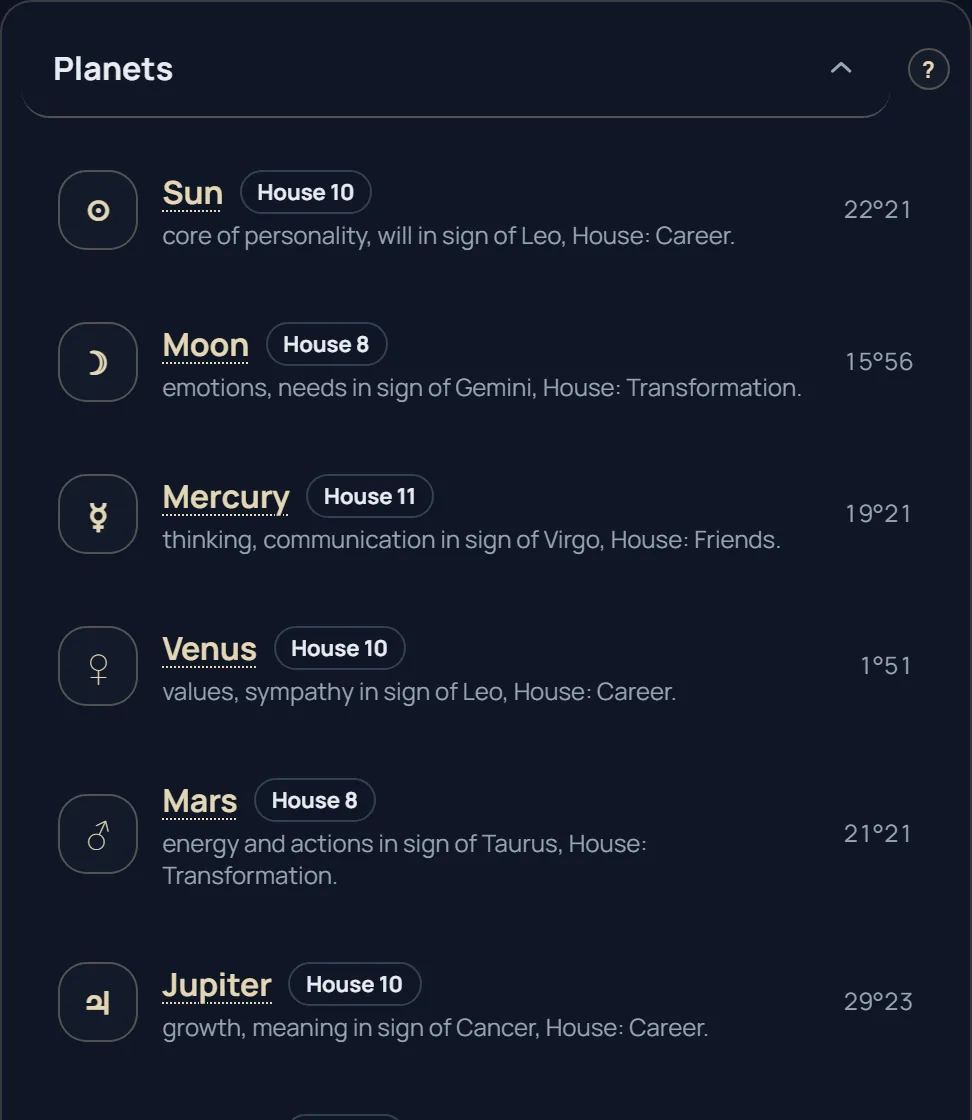
- The Sun, Moon, and planets in signs
- The Ascendant or Rising sign
- The house cusps
- The main angles, especially the Ascendant and Midheaven
- The aspects, or geometric relationships between planets
This is why a calculator result is more detailed than Sun sign astrology. Sun sign astrology uses one placement. A natal chart calculator builds a full layout.
What a birth chart calculator does not calculate
A calculator can generate positions. It does not automatically produce a good interpretation.
It does not know:
- which themes matter most in a beginner reading
- which placements should be read together
- how to separate core tendencies from temporary timing techniques
- how to turn symbols into plain-language meaning
That is where many new readers get stuck. They open a chart, see a long list of placements, and treat every line as equally important. In practice, some parts deserve attention first.
A useful calculator gives data. A useful reading gives order.
If you want a clean example of what a beginner-friendly output should include, see Digital Birth Chart Report: What It Should Include for Beginners.
Which inputs affect the calculation?
Not every input changes the chart in the same way.
Birth date
The birth date affects planetary sign placements, especially for the faster-moving bodies. Even with date alone, a calculator can often place the Sun sign correctly. But date alone is not enough for a full natal chart reading.
Birth time
Birth time is the biggest difference between a partial chart and a full one.
It affects:
- the Rising sign
- the house system output
- the chart angles
- sometimes the Moon's degree, depending on timing
A missing or inaccurate birth time can completely change the houses and may change the Rising sign. That means the chart's outward style, life-area emphasis, and reading sequence can shift.
Birth location
Birth location matters because the chart is calculated from a specific place on Earth. It affects the local horizon and meridian, which shape the Ascendant, Midheaven, and house layout.
Two people born at the same moment in different places can share many planetary sign placements while having different house placements and angles.
Why birth time and location matter so much
Beginners often wonder why a chart calculator asks for a town or city instead of just a date. The short answer is that astrology charts are location-based sky maps.
The calculator is not only asking, "Which sign was each planet in?" It is also asking, "Which part of the sky was rising and culminating at that place and time?"
That is what creates the Ascendant and houses. And those are central to reading style and emphasis.
A practical example:
- With only a birth date, a chart may show Sun in Virgo.
- With a birth time and location added, the same chart may show Virgo Sun, Aries Rising, Moon in Capricorn, with the Sun in the 6th house.
Those added layers change the reading from a broad Sun-sign sketch into a more usable baseline:
- Sun: core drive and basic style of self-expression
- Moon: emotional habits and instinctive responses
- Rising sign: outward approach, pacing, and first impression
- House placement: where that energy tends to show up most clearly
For a cleaner comparison between the big three and the full chart, see Birth Chart Logic: Big Three vs Full Chart and What Actually Changes.
What a beginner should read first in a natal chart
Do not start by reading every planet one by one. Start with the chart's basic frame.
Here is the best beginner order.
1. Read the Big Three
Start with:
- Sun sign
- Moon sign
- Rising sign
This gives a quick baseline.
A simple reading lens:
- Sun: how identity and effort tend to be organized
- Moon: how comfort, stress, and reactions tend to work
- Rising: how a person meets situations and appears to others
This is the fastest way to move beyond one-sign astrology without getting lost.
2. Check the houses of the Sun and Moon
After signs, check where the Sun and Moon land by house.
This answers a practical question: where do these tendencies show up most often?
Examples:
- A Sun in the 10th house may point attention toward visibility, responsibility, and public roles.
- A Moon in the 4th house may shift attention toward privacy, home base, and emotional grounding.
- A Sun in the 3rd house may express more through learning, speaking, errands, or local networks.
The sign describes style. The house describes life area.
3. Find the chart ruler
The chart ruler is the planet that rules the Rising sign. This is a practical shortcut because it links the outward style of the chart to one planet that deserves extra attention.
For example:
- Aries Rising -> Mars becomes the chart ruler
- Taurus Rising -> Venus becomes the chart ruler
- Gemini Rising -> Mercury becomes the chart ruler
Then ask:
- What sign is that planet in?
- What house is it in?
- Does it connect strongly to the Sun or Moon?
This step helps the chart feel less random.
4. Look for repeating elements
Before reading every aspect, look for repetition.
Notice if the chart clusters around:
- one element such as fire, earth, air, or water
- one modality such as cardinal, fixed, or mutable
- one house area
- one planet receiving a lot of contact
Repetition usually matters more than isolated details.
If a chart shows several placements in earth signs, the reading may lean toward practicality, material reality, and steady pacing. If many placements sit in angular houses, the person may come across more directly or visibly. These are not guarantees. They are patterns worth weighting more heavily.
5. Read major aspects last
Aspects matter, but they are easier to understand after the main structure is clear.
Start with major aspects involving:
- the Sun n- the Moon
- the chart ruler
- the Ascendant
- the Midheaven
Keep the first pass simple. Ask whether an aspect shows:
- easy flow
- friction
- emphasis
- tension that creates action
Do not try to interpret every minor line in the chart at once.
For a less jargon-heavy process, see How to Read Your Birth Chart Without Getting Lost in Astrology Terms.
A simple step-by-step reading example
Imagine a calculator returns this basic snapshot:
- Sun in Libra
- Moon in Scorpio
- Rising sign in Capricorn
- Sun in the 9th house
- Moon in the 11th house
- Saturn as chart ruler in the 2nd house
A beginner does not need to decode the full chart at once. Read it in layers.
Layer 1: Big Three
- Libra Sun may point toward balance, comparison, and relational thinking.
- Scorpio Moon may suggest private emotional processing and strong instinctive reactions.
- Capricorn Rising may shape the outward style as measured, contained, or goal-aware.
Already, the reading is more nuanced than "Libra means friendly."
Layer 2: House emphasis
- The Sun in the 9th house may shift expression toward learning, worldview, teaching, publishing, or long-range perspective.
- The Moon in the 11th house may bring emotional intensity into friendships, groups, networks, or shared ideals.
Now the reading is tied to life areas, not just adjectives.
Layer 3: Chart ruler
- Saturn ruling the Capricorn Ascendant becomes important.
- If Saturn sits in the 2nd house, themes around security, values, resources, and pacing may carry extra weight.
That gives the reader a practical synthesis: relationship-minded identity, guarded emotional habits, a serious outer style, and strong focus on structure and stability.
This kind of reading is not fortune-telling. It is a way to organize the chart into themes that can be observed and reflected on.
What changes the interpretation beyond Sun sign astrology?
Four things make the biggest difference.
1. The Moon sign
The Moon often explains reactions that the Sun sign alone cannot. A person may identify with one style in public but process stress or closeness very differently.
2. The Rising sign
The Rising sign changes the outer presentation and sets the entire house structure. This is one of the main reasons two people with the same Sun sign can read very differently.
3. House placements
House placements show where themes tend to play out: work habits, home life, friendships, partnerships, learning, visibility, and more.
4. Aspects
Aspects show how different parts of the chart interact. They can increase tension, ease, focus, or contradiction between placements.
That is why a natal chart reading should not stop at the Sun sign. The chart becomes useful when you read interactions, not just labels.
Common beginner mistakes when using a natal chart calculator
Treating every placement as equally important
Start with the Big Three, houses, and chart ruler. Save the rest for later.
Ignoring birth time accuracy
If the time is uncertain, be cautious with the Rising sign and house interpretations. Those are often the first areas affected.
Reading signs without houses
A sign tells you how something works. A house helps tell you where it tends to show up.
Taking one keyword too literally
Words like "intense," "practical," or "independent" are not complete readings. Use them as clues, then look at the surrounding chart context.
Expecting the calculator to do the interpretation for you
Software can generate clean data. Interpretation still requires order, judgment, and plain-language synthesis.
How to use a birth chart calculator well
Use the tool with a short checklist:
- Enter the most accurate birth date possible.
- Confirm the exact birth time if available.
- Use the correct birth location.
- Read the Big Three first.
- Check the houses of the Sun, Moon, and chart ruler.
- Look for repeated patterns before analyzing every aspect.
- Treat the result as a reflection framework, not as proof or prediction.
That approach keeps the chart readable and grounded.
FAQ
Which inputs affect the calculation most?
Birth time and location have the biggest effect on the Rising sign, houses, and chart angles. Birth date is essential, but time and place turn a basic sign list into a full chart structure.
Why do birth time and location matter?
They determine the local sky orientation at birth. That changes the Ascendant, Midheaven, and house layout, which strongly affect how the chart is read.
What should a beginner read first in a natal chart?
Start with the Sun, Moon, and Rising sign. Then check the houses of the Sun and Moon, identify the chart ruler, and only after that move to major aspects.
What changes the interpretation beyond Sun sign astrology?
The Moon sign, Rising sign, house placements, and aspects add the detail that Sun sign astrology leaves out. These layers help explain differences in style, emphasis, and pattern.
Can a birth chart calculator work without a birth time?
It can generate a partial chart, but the reading will be limited. Without a reliable birth time, the Rising sign and houses may be wrong or unavailable.
Final takeaway
A birth chart calculator is a mapping tool, not a finished reading. It calculates positions from date, time, and location. The real skill is knowing what to read first.
For beginners, the clearest path is simple: start with the Big Three, place them in houses, find the chart ruler, and look for repeated themes before worrying about every detail. That is the point where a calculator result starts to become a readable natal chart.