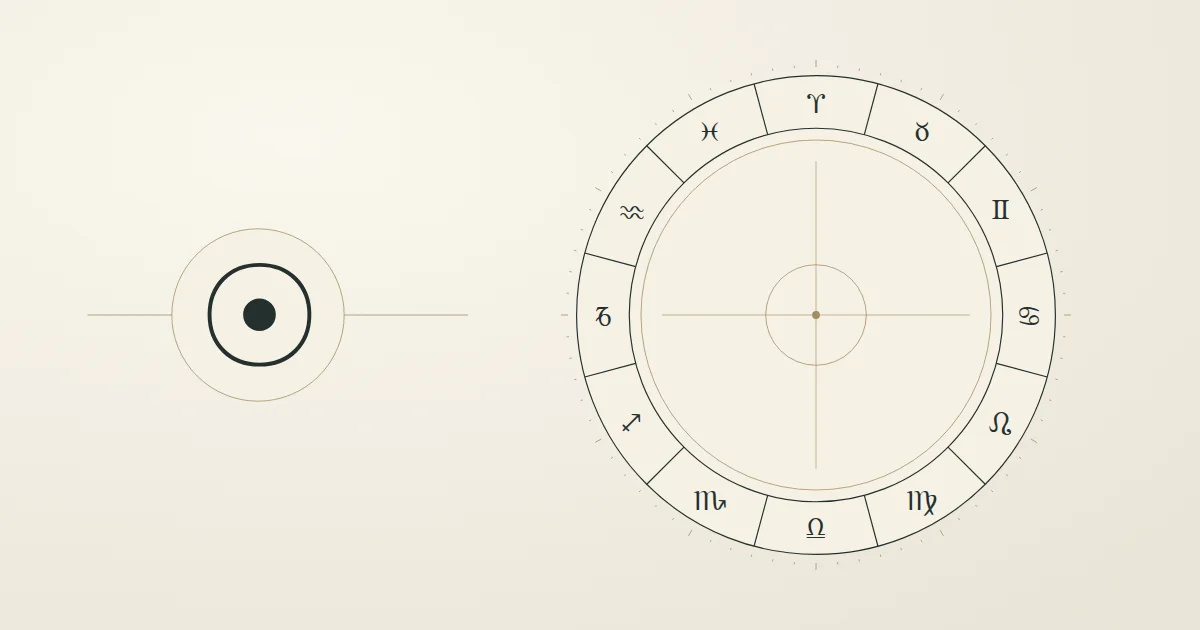
The Midheaven and 6th house offer different kinds of clues about work. In traditional astrological interpretation, the Midheaven is read for public direction, reputation, and the kind of contribution someone may want to make; the 6th house is read for routines, responsibilities, and the conditions of daily work. Neither one, by itself, names a specific career or determines what someone will do.
The practical distinction is between where work is pointing and how work gets done. Reading both can help frame questions about career direction and work style without treating one placement as a verdict.
Midheaven: public direction and contribution
The Midheaven, often abbreviated MC, is the chart point associated in astrology with visibility, public role, and longer-term direction. A reader might consider its sign, any planets close to it, and its ruling planet when exploring what kinds of responsibility or contribution feel worth pursuing.
This is not simply a job-title indicator. A Midheaven reading may raise questions such as: Does the person want to lead, build expertise, serve a visible audience, or work toward a defined public reputation? Those are prompts for reflection, not established facts about personality or a forecast of status.
For example, someone considering a move from individual specialist work into management might use the Midheaven as one lens on the kind of public responsibility they want. The useful question is not “Which job does this placement promise?” but “What type of contribution would I like my work to be known for?”
6th house: daily work and operating conditions
The 6th house is commonly interpreted as the part of the chart connected with everyday responsibilities, routines, service, and the practical conditions of work. Its sign, planets, and ruler can prompt questions about preferred structure: varied tasks or repetition, independent execution or close coordination, flexible rhythms or clear procedures.
These symbols do not confirm how someone behaves on the job. Compare them with observable experience: Which tasks hold attention? Where do handoffs create friction? What kind of schedule has proved workable? That evidence makes a symbolic reading more specific and useful.
For instance, a person may value a visible, high-impact career direction but find that unpredictable schedules make sustained work difficult. The 6th-house lens brings the day-to-day requirements into view: workload, task design, routines, and support. It does not decide whether the person should accept a role.


The difference in practice
| Question | Midheaven | 6th house |
|---|---|---|
| Main focus | Public direction, contribution, and reputation | Daily tasks, routines, and responsibilities |
| Useful work question | What kind of contribution do I want to build toward? | What conditions help me carry out the work consistently? |
| Example | Choosing between a specialist path and a public-facing leadership role | Comparing a predictable workflow with a role full of shifting tasks |
| Common misreading | Treating it as a guaranteed job title or level of success | Treating it as a fixed description of work habits |
In brief, the Midheaven speaks to the broader direction someone is considering; the 6th house brings attention to the repeated tasks and conditions that make that direction workable—or difficult to sustain.
How to read both without forcing a career label
Start with a real decision or question. “What career am I destined for?” is too broad to test against experience. “Would I rather develop deep expertise or take on public-facing responsibility?” gives the symbols a practical point of comparison.
Then use a simple sequence:
- Read the Midheaven as a direction prompt. Note its sign, any nearby planets, and the condition of its ruler. Translate the symbolism into possible forms of contribution, not a list of prescribed occupations.
- Read the 6th house as a work-design prompt. Consider its sign, planets, and ruler. Ask what these symbols invite you to examine about tasks, structure, service, and routine.
- Compare the two with lived evidence. Look at past roles, feedback, responsibilities, and working conditions. Separate what has actually happened from what the chart symbolism suggests you might explore.
- Add other relevant chart factors only when they clarify the question. The 2nd house is often considered in astrology for resources and earning, while the house rulers and aspects can add context. More indicators do not remove uncertainty; they should sharpen the question rather than manufacture certainty.
A hypothetical comparison
Suppose a sample chart has a Midheaven at 12° Virgo and a 6th-house cusp at 12° Aquarius. These degrees are illustrative, not a real person’s birth data. The calculation step is to establish the chart’s angles and house cusps from a reliable birth date, time, and place; the example then compares the signs at the Midheaven and 6th-house cusp. Astrological interpretation might associate Virgo symbolism with precision or improvement in public contribution, and Aquarius symbolism with experimentation or systems in daily work. Those associations are interpretations, not calculated facts about the person.
A practical reading would turn that contrast into questions: Is careful, improvement-focused work a direction worth pursuing? Do experimental or less conventional workflows suit the actual role? The answers come from experience and judgment, not from the degrees alone. Without a reliable birth time, the Midheaven and house cusps may be uncertain, so this comparison should not be treated as dependable.
Keep symbolic reading separate from career decisions
Astrology is a symbolic tradition and can serve as a reflection framework; it is not validated proof of aptitude, a reliable career assessment, or a way to predict employment or income. A chart cannot establish that someone will succeed in a field or that a particular job is right for them.
For a practical choice, pair reflection with concrete information: the role’s duties, schedule, pay terms, required skills, growth options, and the person’s own experience. The chart can help organize questions about direction and work conditions, but the decision still depends on evidence and personal priorities.
Saturn and Jupiter are sometimes used in astrological readings to discuss responsibility and growth opportunities. Those themes may offer a way to reflect on limits, commitments, or options, but they do not prove that a specific obstacle or opening will occur. Keep the focus on what is actually changing at work and which choices are available.
For related perspectives, see how to read career astrology for clearer work and money decisions and what to notice when work or money starts shifting.
To apply this method, AstryHub’s natal chart calculates the 2nd, 6th, and 10th houses, their rulers, and the planets in them from birth date, time, and place. Those chart details are calculated; deciding how well their symbolic themes fit real work experience remains a matter of your own judgment.
FAQ
Is the Midheaven more important than the 6th house for career?
Neither is automatically more important. The Midheaven is commonly read for public direction and contribution, while the 6th house brings attention to daily work and conditions. Which is more relevant depends on the question being explored.
Does the 6th house show what job someone should do?
No. It may offer symbolic prompts about routines and responsibilities, but it cannot identify a suitable job as a fact. Compare any interpretation with actual skills, preferences, and working conditions.
Can the Midheaven name a specific profession?
It should not be treated as a job-title predictor. A reader may use it to consider public direction or contribution, then explore possible roles using real-world information and experience.
What if the birth time is unknown or unreliable?
The Midheaven and houses depend on birth time, so they may be uncertain when that time is not reliable. Do not treat an assumed time as a recovered one; check whether a trustworthy time is available before relying on house-based comparisons.