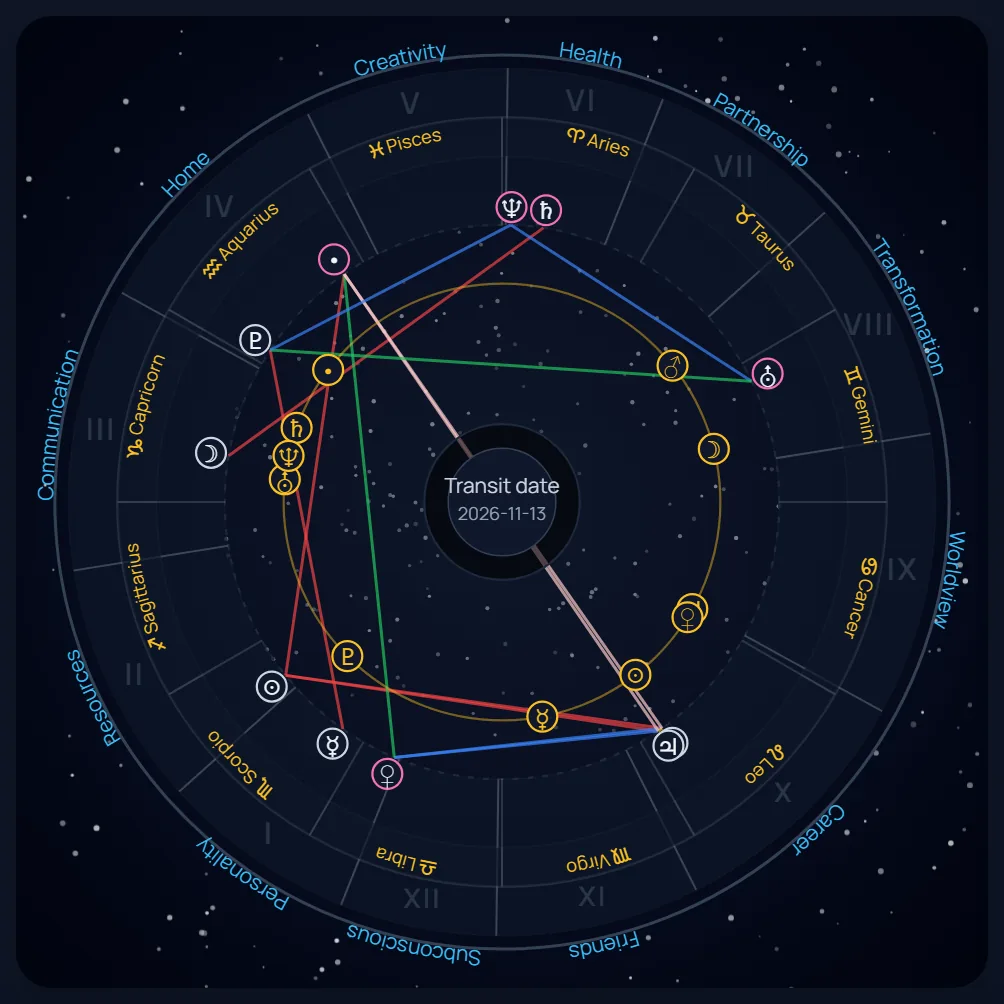
Current transits become useful when they are read in context, not as isolated keywords. A Mars transit is not just "energy." A Saturn transit is not automatically "bad." The real interpretation comes from three layers working together: the transiting planet, the natal planet or angle it touches, and the house topics it activates.
That is the difference between a vague forecast and a usable reading.
Start with the right transit question
Most beginners ask, "What is happening in the sky today?" A better question is, "What is being activated in the natal chart right now?"
That shift matters because transits do not mean the same thing for everyone. The current sky sets a general climate, but the personal reading begins where that climate lands in the natal chart.
Use this order:
- Identify the transiting planet.
- Find what natal planet, angle, or point it is contacting.
- Note the aspect between them.
- Check which natal house is being transited.
- Check the house ruled by the natal planet being contacted.
- Judge timing by speed, repetition, and intensity.
If that sounds technical, it gets easier once each step has a job.
Step 1: Read the transiting planet as the trigger
The transiting planet describes the type of pressure, motion, or attention entering the chart.
A simple way to read it:
- Sun, Mercury, Venus, Mars: faster triggers. These often describe short-term mood, conversation, scheduling, desire, friction, or action.
- Jupiter and Saturn: medium-to-long cycles. These often describe growth, responsibility, pacing, limits, effort, or restructuring.
- Uranus, Neptune, Pluto: deep background shifts. These tend to work slowly and are usually felt most clearly when they hit natal planets or major angles closely.
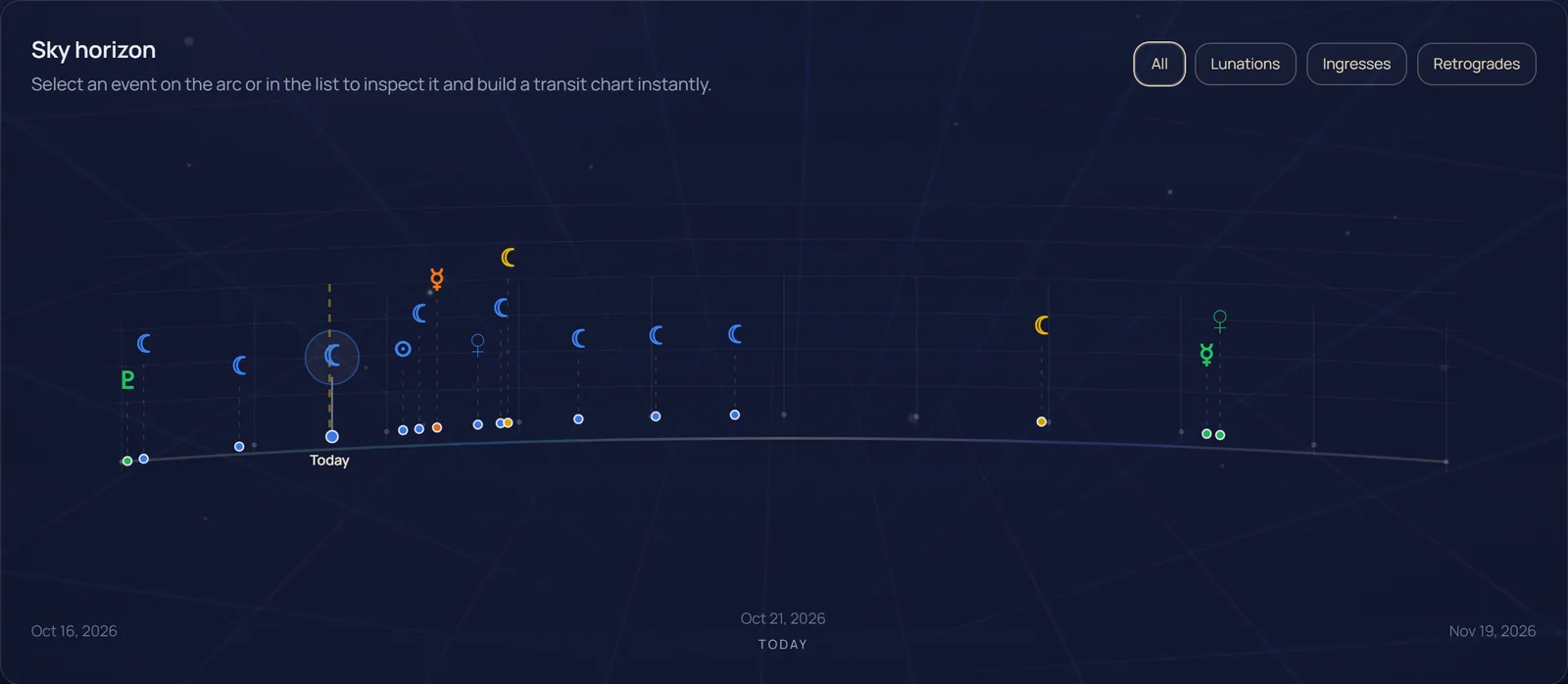
- Lunations: short windows of emphasis. New and full moons can highlight a topic already active through bigger transits.
Think of the transiting planet as the verb. It shows what kind of action is taking place: pushing, clarifying, slowing, expanding, reviewing, disrupting, or deepening.
If the basics of transit language still feel slippery, this background piece can help: Planetary Transits Explained: What They Are and Why They Matter.
Step 2: Read the natal planet as the life function being activated
The natal planet shows what part of the person’s usual pattern is being contacted.
A quick working guide:
- Natal Sun: identity, visibility, direction, will
- Natal Moon: habits, emotional rhythm, comfort, response patterns
- Natal Mercury: thinking, speaking, paperwork, learning, coordination
- Natal Venus: preferences, taste, relationships, values, money habits
- Natal Mars: drive, conflict style, effort, assertion
- Natal Jupiter: confidence, belief, growth style, tolerance for risk
- Natal Saturn: structure, pressure tolerance, discipline, obligations
- Angles (Ascendant, Midheaven, Descendant, IC): major life areas and external shifts in presentation, home, relationships, or work direction
This is where interpretation becomes personal without becoming fatalistic. A transit to natal Mercury and a transit to natal Saturn may happen under the same sky, but they do not describe the same kind of pressure.
Step 3: Let the aspect show how the transit behaves
The aspect tells you how the transit interacts with the natal pattern.
Use aspects as behavior, not as moral labels.
- Conjunction: direct contact, concentration, amplification
- Sextile: openings that still require action
- Square: friction, pressure, adjustment, decision stress
- Trine: easier flow, support, momentum, lower resistance
- Opposition: tension across two ends, relationship or balance issues
A square is not automatically negative. It often gets attention because it creates enough friction to force a response. A trine is not automatically better. It can pass quietly if nothing is done with it.
Step 4: Use houses to locate where the transit shows up
Houses answer the practical question: where is this likely to be noticed?
Two house layers matter.
The house being transited
This shows the current life area receiving activity.
For example:
- Transit in the 3rd house may show up through communication, planning, errands, siblings, local movement, or admin.
- Transit in the 6th house may show up through workload, routines, maintenance, time management, or health habits.
- Transit in the 10th house may show up through public role, responsibility, leadership, visibility, or career direction.
The house ruled by the natal planet being hit
This is the step many readers skip, and it often sharpens the interpretation fast.
If transiting Saturn aspects natal Venus, the reading is not only about Venus topics in general. It also helps to check which houses Venus rules in the natal chart. That can connect relationship or money themes to very specific life areas, such as home, work, or shared resources.
This is one of the main answers to the question, "How do houses and natal aspects change a transit interpretation?" They move the reading from generic symbolism to an actual pattern in lived life.
Step 5: Check natal aspects before making a judgment
A transit rarely acts alone. It tends to wake up the natal aspect pattern around the planet being touched.
Example:
- If natal Venus is tightly square natal Saturn, then a current transit to Venus may also stir up that built-in Venus-Saturn pattern: caution, reserve, standards, fear of waste, or pressure around closeness and value.
- If natal Mercury is trine natal Jupiter, then a current transit to Mercury may also activate the chart’s natural tendency toward broad thinking, teaching, publishing, or overextension.
This is what actually changes when slow transits activate natal patterns. The transit does not create a brand-new personality. It presses on existing wiring, and the result often shows up as stronger awareness, more external demand, or less room to ignore a long-running pattern.
Step 6: Judge timing by speed and repetition
Not every transit deserves equal attention.
A useful priority system:
Fast transits
Moon, Mercury, Venus, and Mars can describe short-term mood, pace, interaction, irritation, or momentum. These are useful for weekly reading, but they usually do not define a whole season unless they trigger something larger.
Medium transits
Jupiter and Saturn often describe the bigger lesson, workload, opening, or restructuring phase. These are usually worth tracking over months.
Slow transits
Uranus, Neptune, and Pluto matter most when they closely contact natal planets, angles, or repeating chart hot spots. Their influence builds over time and tends to work through repeated passes.
Repeating hits matter more than single hits
If a transit applies, perfects, then returns because of retrograde motion, that repetition usually makes the theme more noticeable. The first pass can introduce the issue. The second can review or complicate it. The final pass can bring clearer action or closure.
For a simpler weekly filter, this guide is useful: Current Transit Analysis for Beginners: How to Read What Matters.
How to read retrogrades without turning them into superstition
Retrogrades are often overdramatized. A better approach is to treat them as timing modifiers.
Retrograde periods can coincide with:
- review instead of fresh momentum
- unfinished conversations resurfacing
- delays that expose weak planning
- revisions, edits, repairs, or rethinking
- repeated contact with the same issue
That does not mean life stops. It means the style of progress may change.
When reading a retrograde transit against a natal chart, ask:
- What planet is retrograde?
- What natal planet or house is it contacting?
- Is this the first, second, or third pass?
- What needs refinement rather than force?
This keeps the reading practical and avoids daily horoscope fluff.
A simple transit reading formula
Use this sentence structure:
Transiting planet + aspect + natal planet/angle + house context + timing note
Example formula:
Transiting Saturn square natal Mercury in the 6th house may coincide with heavier mental workload, stricter deadlines, or a need to simplify systems, especially if Mercury rules the 9th and 12th houses.
That is already more useful than saying, "Saturn brings challenges."
Practical examples
Example 1: Saturn transit to natal Mercury
A grounded Saturn transit meaning often includes pressure, accountability, realism, pacing, and structure.
If transiting Saturn aspects natal Mercury, possible themes may include:
- serious conversations
- mental fatigue from overcommitment
- editing, studying, or technical concentration
- tighter standards in writing or communication
- a need to cut noise and build a workable routine
Now add house context:
- In the 3rd house, this may show up through admin backlog, scheduling strain, commuting burdens, or careful communication.
- In the 6th house, it may point more clearly to workflow, deadlines, systems, and maintenance.
- If natal Mercury rules the 10th house, work visibility or responsibility may become part of the story.
Now add natal aspect context:
- If natal Mercury is already under tension from Mars, the transit may feel sharper or more reactive.
- If natal Mercury is supported by Saturn natally, the same transit may align more naturally with focused work and disciplined thinking.
Example 2: Jupiter transit to natal Venus
This is often reduced to "good luck in love," which is far too thin.
A better read might include:
- wider social flow
- more spending or generosity
- easier rapport
- stronger appetite for pleasure or comfort
- growth in Venus-ruled matters, with a need for proportion
House context changes everything:
- In the 2nd house, this may relate to spending choices, values, pricing, or material comfort.
- In the 7th house, it may be felt through agreements, collaboration, or relationship tone.
- If natal Venus rules the 11th house, friends, networks, or group involvement may become part of the picture.
The point is not to force a positive reading. Jupiter can increase whatever it touches, including excess.
Example 3: Mars triggering a slow transit
Suppose a slow Saturn or Pluto transit is already active to a natal angle. A quick Mars transit to the same degree area can act like a spark.
That might coincide with:
- the week the issue becomes visible
- the conversation that forces action
- the burst of urgency inside a longer process
This is why daily transit reading works best when connected to the bigger cycle already running.
A weekly method that does not waste time
For a useful beginner workflow, track transits in three layers.
1. The central tone of the week
Look at the biggest active transits first. Usually that means slow planets to natal planets or angles, plus any major Jupiter or Saturn contacts. This gives the week its background mood, focus, and pace.
2. The current trigger
Then check faster planets. Ask what is activating the larger pattern right now. A Mars square or Mercury conjunction may explain why one day feels busier, sharper, or more decision-heavy than the rest.
3. The near-future emphasis
Finally, look ahead to the next lunation or upcoming exact transit. Not for prediction, but for preparation. What topic is gathering weight? What process needs cleaner timing, better communication, or more realistic pacing?
Common mistakes when reading transits to a natal chart
Reading only the transiting sign
Sign-only transit reading is too broad for personal interpretation. It may describe the weather, but not where it lands.
Treating every transit as equally important
A Moon transit and a long Saturn transit do not deserve the same interpretive weight.
Ignoring natal aspects
The natal chart shows how a person tends to process pressure, support, speed, and change. Without that, transit interpretation stays generic.
Assuming one transit predicts one event
Transits are better used as a framework for noticing themes, timing pressure, and decision patterns. They do not offer reliable certainty about exact outcomes.
Making retrogrades sound dramatic
Retrogrades are often about revision, repetition, and pacing. That is useful enough without adding superstition.
A compact checklist for personal transit interpretation
Before finishing a reading, ask:
- What is the main transit?
- How close is it?
- Is it fast, medium, or slow?
- What natal planet or angle is involved?
- What house is being transited?
- What house does the natal planet rule?
- What natal aspects are being activated?
- Is this a first pass or a repeat due to retrograde motion?
- What real-life behavior fits the symbolism: pressure, delay, revision, conflict, visibility, focus, expansion?
If the reading cannot answer those questions, it probably needs less symbolism and more structure.
FAQ
How do houses and natal aspects change a transit interpretation?
Houses show where a transit is likely to be noticed in daily life. Natal aspects show how that activation plugs into the existing chart pattern. Together they turn a broad transit meaning into a more precise reading.
How should a reader use transit astrology without daily horoscope fluff?
Focus on activation, not slogans. Start with major current transits to natal planets and angles. Then use fast transits as short-term triggers inside that larger cycle. That keeps the reading concrete and avoids vague sign-based generalizations.
What actually changes when slow transits activate natal patterns?
Slow transits tend to intensify existing patterns rather than invent new ones from nowhere. The shift may show up as more pressure, less avoidance, stronger awareness, or a longer period of restructuring around the natal planet involved.
Is a Saturn transit always difficult?
Not always. Saturn often correlates with pressure, responsibility, limits, and realism, but that can also support steadier systems, cleaner commitments, and better boundaries. Much depends on the natal planet involved, the houses activated, and whether the transit is asking for pruning, discipline, or patience.
Should beginners track transits every day?
Usually not in full detail. A weekly review is often more useful. Track the major ongoing transits first, then note the faster triggers that briefly sharpen the tone.
The simplest way to get better at reading transits
Read fewer transits, but read them more completely.
One Saturn contact interpreted through planet, aspect, house, rulership, and timing will teach more than twenty random daily keywords. That is how natal chart transits become a practical reading tool instead of a stream of disconnected meanings.