Most people meet transits through vague daily horoscope language. That usually makes the idea seem either magical or useless. A transit is neither. In astrology, a transit is simply the current movement of a planet in the sky and the way that movement is interpreted in relation to a chart.
That basic idea matters because transits give astrology its sense of timing. The natal chart describes a pattern. Transits describe when that pattern may feel more active, more visible, or more demanding.
What is a transit in simple terms?
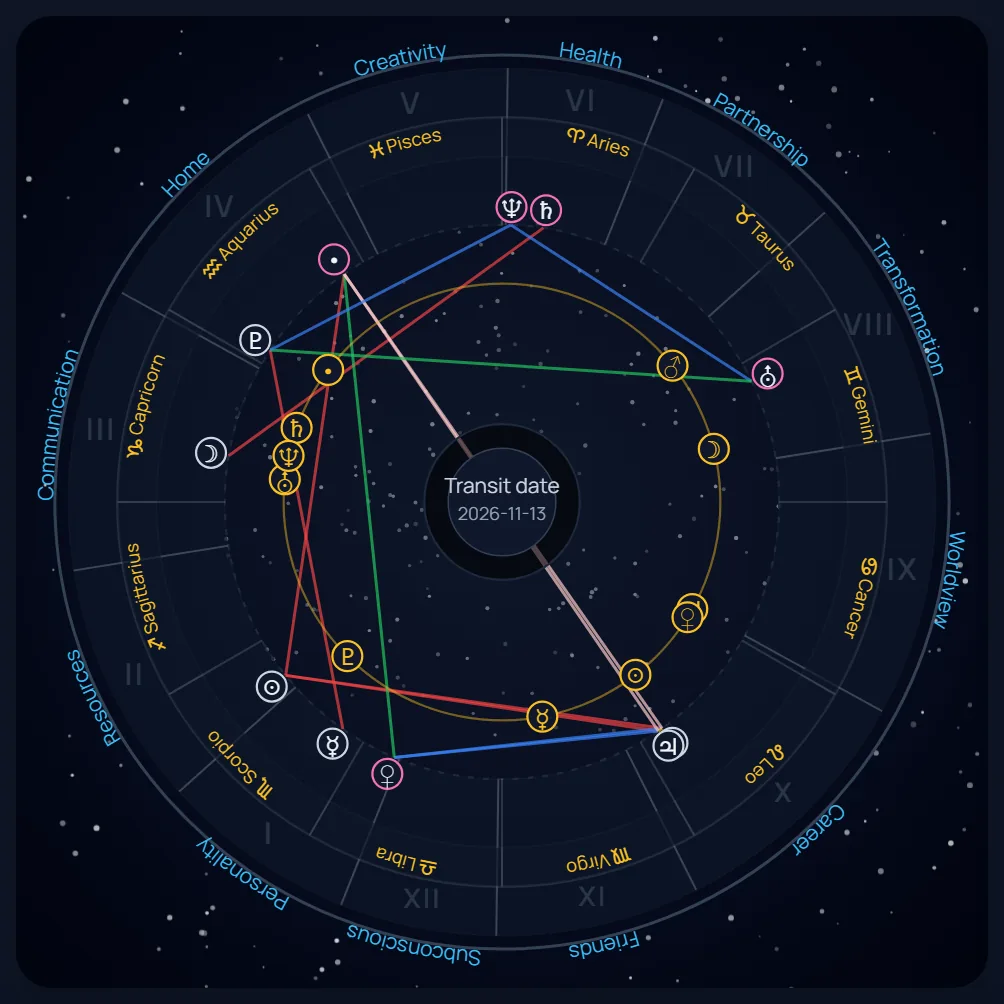
A transit is the present position of a planet compared with a fixed chart, usually a natal chart.
Think of it like this:
- The natal chart is the blueprint.
- Transits are the weather moving across it.
- The meaning comes from the contact between the two.
If that sounds abstract, make it practical. A transit is what astrologers look at when asking questions like:
- Why does one month feel busier or heavier than another?
- Why does a familiar issue come back into focus?
- Why does a decision suddenly feel urgent?
Transits do not prove what will happen. They offer a timing framework for noticing pressure, momentum, review periods, and turning points.
Why transits matter in astrology
Without transits, astrology becomes static. A birth chart alone can describe tendencies, but it does not explain why certain themes come alive at certain times.
Transits add movement. They can help a reader notice:
- when energy speeds up or slows down
- when attention shifts toward work, relationships, or practical obligations
- when a long-building issue asks for action
- when reflection is more useful than pushing ahead
This is why people often search for current planetary transits. They want context for timing, not just personality description.
Why transits must be compared with a natal chart
This is the point beginners miss most often.
Current planetary transits describe the sky for everyone. The reason they do not mean the same thing for everyone is that they land in different places in different charts.
For example, a Saturn transit is often described as serious, disciplined, or demanding. That general tone can be useful. But the actual reading depends on what Saturn is contacting in the natal chart.
A transit becomes more specific when you ask:
- Which natal planet is being contacted?
- What aspect is being made?
- Which house or life area is involved?
- Is the transiting planet fast-moving or slow-moving?
Without that comparison, transit astrology easily turns into broad mood reporting. With the comparison, it becomes a more structured reading tool.
The three building blocks of reading transits
A beginner does not need dozens of techniques. Start with three.
1. The transiting planet
The moving planet shows the type of energy or pressure involved.
A few simple examples:
- Moon: mood, fluctuation, short-term emphasis
- Mercury: thinking, communication, errands, revisions
- Venus: values, taste, relating, attraction, agreements
- Mars: effort, friction, drive, action
- Jupiter: growth, scale, confidence, opportunity to widen perspective
- Saturn: structure, limits, responsibility, consequences, long-term work
This is why searches like Saturn transit meaning are so common. Slow planets often describe periods people actually feel over time.
2. The aspect
An aspect is the angle between the transiting planet and a natal planet or point. In beginner work, the main question is simple: does the contact feel easy, activating, or demanding?
A stripped-down way to think about common aspects:
- Conjunction: intensifies the topic
- Sextile: opens a manageable opportunity
- Square: creates friction or pressure to adjust
- Trine: allows flow or easier expression
- Opposition: brings tension, contrast, or external feedback
The aspect does not guarantee good or bad outcomes. It suggests the style of the moment.
3. The house or life area
Houses show where the transit is likely to be noticed.
If a transit hits a career-related part of a chart, the person may notice it through workload, visibility, authority, or long-range planning. If it hits a relationship area, the same transit may show up through boundaries, commitment questions, or changed expectations.
This is one reason generic transit posts often feel thin. They describe planetary mood but skip the area of life where it actually lands.
Fast transits vs slow transits
Not all transits carry the same weight.
Fast transits
The Moon, Mercury, Venus, and Mars move relatively quickly. Their transits are useful for short-term tone.
They can describe:
- a mentally busy day
- a touchier conversation cycle
- a more social week
- a burst of motivation or irritation
These are good for reading the week ahead, but they are usually not the whole story.
Slow transits
Jupiter, Saturn, Uranus, Neptune, and Pluto move much more slowly. Their transits often coincide with longer chapters of development, pressure, revision, or change.
Slow transits matter because they repeat, linger, and deepen. They may not describe a single event. They often describe a process.
That process can look like:
- building a new skill over time
- facing limits that force better structure
- outgrowing an old role
- seeing a pattern more clearly than before
When people say a transit changed a period of life, they are usually talking about a slower transit, not a quick Moon contact.
What actually changes when slow transits activate natal patterns?
Usually not fate. Usually attention, pressure, and timing.
A slow transit tends to make a natal pattern harder to ignore. If the natal chart shows a tension between freedom and stability, a major transit may bring circumstances that highlight that tension. If the chart shows strong ambition but weak pacing, a heavy Saturn period may make time management, responsibility, or limits impossible to avoid.
The transit does not create a brand-new personality. It activates a pattern that was already part of the chart.
That is why slow transits can feel so significant. They do not just pass through the surface. They press on existing structure.
How to read current planetary transits without horoscope fluff
A useful transit reading starts broad and then gets specific.
Step 1: Check the general sky tone
Start with the current planetary transits as a shared backdrop. Ask:
- Is the general pace fast or slow?
- Is the emphasis on action, review, discipline, or expansion?
- Are several planets pointing toward the same theme?
This gives context, not a final answer.
Step 2: Separate short-term mood from long-term cycles
Do not treat every transit as equally important.
A tense Moon day may reflect temporary emotional weather. A long Saturn contact may describe a months-long period of tests, consolidation, or serious work. If you mix those together, everything feels dramatic and nothing becomes clear.
Step 3: Find the natal contact
This is where transit astrology becomes personal rather than generic. Look for which natal planet or angle the transiting planet is contacting.
Then ask:
- What does that natal planet represent?
- How does the transit aspect modify it?
- Is this a brief trigger or a long cycle?
Step 4: Translate symbolism into real behavior
This step prevents mystical overreach.
Instead of saying, “This transit means success” or “This transit means crisis,” ask what observable pattern fits the symbolism.
For example:
- More deadlines and less tolerance for delay
- More reflection before signing, sending, or deciding
- More pressure to define priorities
- More friction around pace and energy use
The reading becomes more grounded when it points to behavior and choices.
A simple beginner framework for reading the week ahead
If you want to use transits weekly, keep the method light.
Look for the central tone
Every week has a mood, focus, and pace. A practical transit check asks:
- What seems louder than usual this week?
- What requires patience?
- What is moving quickly?
- What needs review instead of reaction?
This avoids the trap of treating astrology as minute-by-minute prediction.
Track three things only
For a cleaner weekly reading, track:
- One fast transit affecting short-term mood or communication
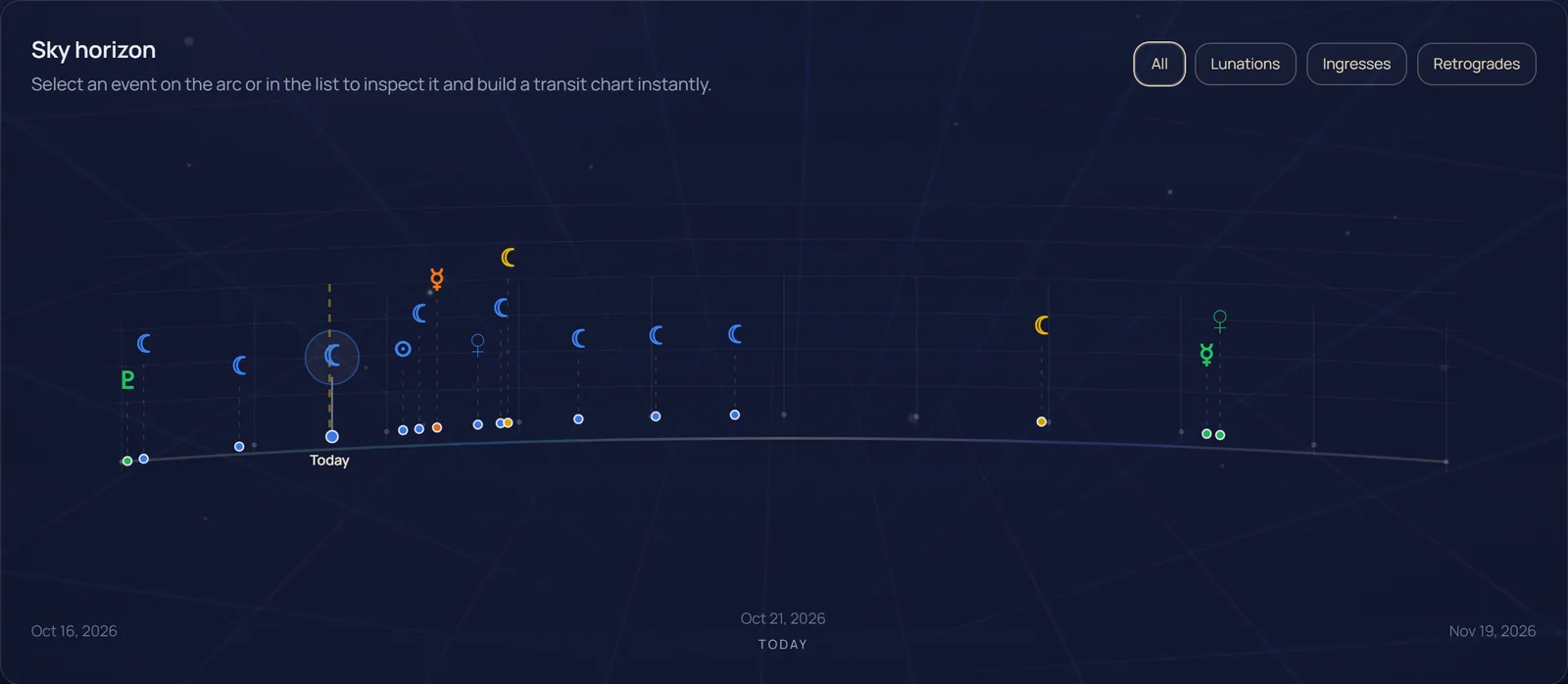
- One lunation theme such as a new beginning or a culmination point
- One slow transit shaping the deeper background
That combination is usually enough for a useful week-ahead view.
Where lunations and retrogrades fit in
Beginners often hear about full moons, new moons, and retrogrades before they understand transits as a whole. These are part of the same system.
Lunations
New moons and full moons are timing markers. They are often used to highlight beginnings, endings, or moments when a topic becomes more visible.
Used well, lunations can help a reader notice where momentum is building or where something is ready for review. Used badly, they turn into overblown event claims.
Retrogrades
A retrograde is an apparent backward motion from Earth's point of view. In interpretation, retrogrades are often linked with revision, delay, reconsideration, and unfinished business.
That does not mean life stops. It means the normal forward push of a planet's themes may become less direct. Mercury retrograde, for example, is better understood as a period that may call for clearer communication and better checking, not panic.
Saturn transit meaning for beginners
Saturn deserves its own section because many readers search for it first.
A Saturn transit usually brings attention to structure. It can coincide with pressure, responsibility, limits, deadlines, maturity, or the need to build something that lasts.
The beginner mistake is to read Saturn as punishment. A better reading is that Saturn asks what is sustainable.
In practice, a Saturn transit may correlate with:
- taking work more seriously
- seeing where poor habits cost time
- facing the gap between plans and execution
- choosing commitment over drift
- simplifying what is not realistic
That is why Saturn periods often feel heavy but useful. They narrow options so priorities become clearer.
A concrete example of how to read a transit
Suppose the current sky shows a strong Saturn emphasis.
A fluffy reading would say: “Everyone will feel blocked.”
A better reading asks:
- Is Saturn making a major contact to the natal chart, or is it only part of the background sky?
- Is the contact a square that creates pressure, or a trine that supports steady effort?
- Which life area is involved?
From there, the interpretation becomes more practical:
- If the contact is strong, this may be a period for realistic planning, stronger boundaries, and slower but more solid progress.
- If the contact is weak, the person may simply notice a more serious public mood or heavier external expectations.
Same transit. Different weight.
Common beginner mistakes with astrology transits
Reading the sky without the chart
General transits are useful context, but they are not a full reading.
Treating every transit like a major life event
Most transits are passing influences. Not every square is a crisis. Not every trine is a breakthrough.
Ignoring timing scale
A Moon transit and a Saturn transit should not be read with the same level of intensity.
Turning symbols into certainty
A transit can describe pressure, not a guaranteed outcome. The point is to read themes, choices, and timing windows with humility.
FAQ
What is a transit in astrology?
A transit is the current position of a planet in the sky compared with a natal chart. Astrologers use that comparison to read timing, emphasis, and changing themes.
Why do transits need a natal chart?
Because the same current sky does not land the same way for everyone. The natal chart shows where the transit falls, what it contacts, and why it matters more in one case than another.
How should a beginner use transit astrology?
Use it as a timing and reflection tool. Start with the shared sky, then look at the natal contact, the aspect, and the life area involved. Focus on patterns and choices rather than fixed predictions.
What do slow transits usually mean?
Slow transits often describe longer periods of development, pressure, or change. They tend to activate natal patterns that were already present rather than creating an entirely new story.
Are retrogrades always bad?
No. Retrogrades are better understood as periods of review, rethinking, and correction. They can be inconvenient, but they are not automatic signs of failure.
Final takeaway
Planetary transits matter because they give astrology a clock. They show when certain themes are louder, heavier, or more workable.
The simple version is enough to start: a transit is a current planet making contact with a natal chart. The useful version goes one step further: identify the planet, the aspect, the life area, and the timing scale.
That is how transits move from horoscope noise into a practical reading framework.