Most people meet astrology through sun sign compatibility. It is simple, memorable, and often too thin to explain why one connection feels easy while another turns into mixed signals, uneven effort, or constant negotiation.
Relationship astrology gets more useful when it stops asking only, "Do these signs match?" and starts asking better questions. How does attraction start? How is affection shown? What makes someone feel secure? Where do boundaries tighten? What kind of closeness feels natural, and what kind feels crowded?
That shift turns astrology from a generic dating shortcut into a framework for reading relationship dynamics.
What relationship astrology is actually trying to describe
At its best, relationship astrology is not fortune-telling about soulmates. It is a symbolic way to map patterns that often show up in connection.
For beginners, four areas matter most:
- Attraction: what pulls attention and creates chemistry
- Affection: how care, warmth, and desire are expressed
- Boundaries: where a person needs space, clarity, or emotional structure
- Closeness style: how someone tends to bond, trust, merge, or stay independent
These areas describe behavior more clearly than broad statements like "fire signs and air signs get along."
A chart does not remove choice, maturity, or context. It gives language for recurring tendencies. That is why two people with strong chemistry can still struggle with pacing, reassurance, commitment, or conflict style.
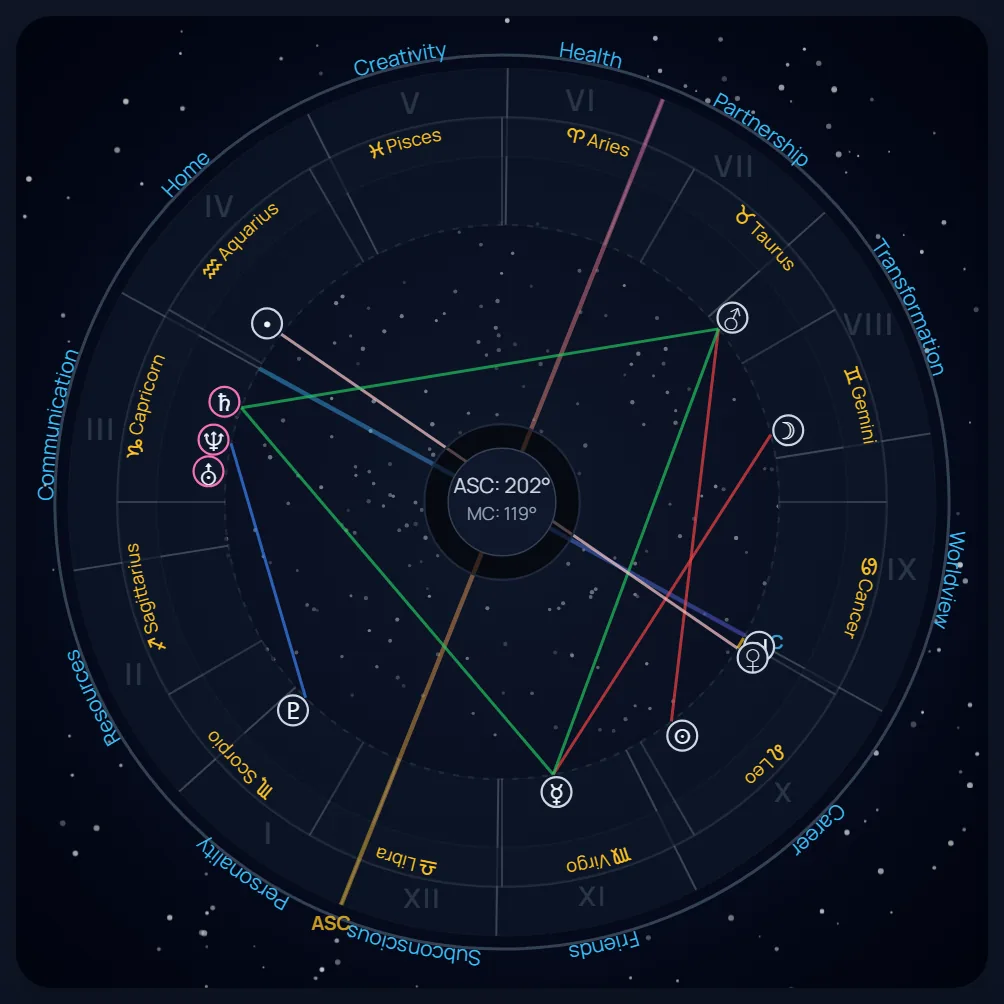
Why sun sign compatibility is not enough
Sun signs matter, but they describe core identity more than day-to-day relating. Two people can admire each other and still miss each other emotionally.
Simple sign compatibility often fails because relationships are not built on one trait. They are built on layered interactions:
- who initiates
- who needs verbal reassurance
- who prefers practical acts over romantic display
- who wants frequent contact
- who needs room to process
- who reads intensity as passion and who reads it as pressure
Astrology can describe those differences, but not through the sun sign alone.
A beginner reading becomes more accurate when it includes markers for love style, attraction, emotional needs, and interpersonal boundaries.
The natal markers that matter more than basic sign matching
If the goal is to understand relationship dynamics without turning generic, focus on a few core factors instead of trying to read everything at once.
Venus: affection, taste, and what feels attractive
Venus is one of the clearest relationship markers for beginners. It helps describe:
- what feels appealing
- how affection is shown
- what kind of charm works
- what makes connection feel pleasant or natural
Venus by sign often shows attraction style. One Venus placement may prefer direct pursuit and obvious chemistry. Another may lean toward steadiness, intelligence, humor, softness, or emotional depth.
Venus by house adds a real-life setting. It can show where affection tends to concentrate. For example, one placement may emphasize private bonding at home, while another may focus on public partnership, shared goals, or playful dating energy.
This is one reason love astrology gets flattened when people stop at sign memes. Attraction is not only about "who likes who." It is also about what kind of relating feels rewarding.
The Moon: emotional habits and comfort needs
The Moon often tells you more about everyday compatibility than the Sun does. It points to emotional rhythm.
Key Moon questions include:
- How is comfort given and received?
- What happens under stress?
- Is reassurance needed through words, routine, touch, privacy, or consistency?
- Does closeness happen quickly or slowly?
Two people can have strong attraction and still feel emotionally mismatched if one needs frequent openness and the other processes feelings indirectly or on a delay.
Mars: pursuit, desire, and friction style
Mars is not only sexual chemistry. It also describes drive, pace, and how conflict gets activated.
Mars can help explain:
- how someone goes after what they want
- whether tension is addressed fast or avoided
- how irritation builds
- what kind of response feels energizing versus abrasive
This matters in compatibility astrology because attraction without workable conflict style tends to burn hot and wear out fast.
The 7th house and relationship focus
The 7th house is one of the classic relationship areas in natal astrology. For beginners, think of it as a clue to partnership pattern.
It can show:
- what a person tends to look for in committed bonds
- what they expect from one-to-one relationships
- what kind of relational dynamic feels important
This does not mean one placement guarantees a certain partner. It means the chart may emphasize particular themes in partnership, such as equality, intensity, practicality, communication, or mutual visibility.
Saturn: limits, responsibility, and boundaries
Saturn is essential when reading relationship boundaries. It often shows where caution, seriousness, delay, or standards come in.
In practical terms, Saturn can describe:
- where trust is earned slowly
- where someone has high expectations
- where fear of vulnerability may create distance
- where commitment is taken seriously rather than casually
Many people look for romance indicators and skip Saturn. That is a mistake. Boundaries and durability matter as much as attraction.
A beginner framework for reading relationship dynamics
A useful reading does not need twenty techniques. Start with a four-part framework.
1. Read attraction separately from compatibility
Attraction answers: What sparks interest?
Compatibility answers: Can the connection function over time?
Those are different questions.
Example:
- Strong Venus or Mars links may create fast chemistry.
- Mismatched Moon patterns may make emotional timing difficult.
- Heavy Saturn contact may add commitment potential, but also pressure.
This helps explain why some connections feel immediate but unstable, while others build slowly and last.
2. Check how affection is expressed
People do not all show care the same way. In astrology, Venus often helps translate that difference.
One style may show love through attention, beauty, flirting, and warmth. Another may show it through reliability, problem-solving, practical help, or quiet consistency.
A common reading mistake is assuming a different style means less feeling. Often it means a different delivery system.
3. Look at emotional pacing
The Moon helps with pace. Some people bond through rapid sharing and frequent check-ins. Others need privacy before they can trust what they feel.
Neither pattern is automatically better. Friction starts when one person reads slowness as disinterest, or reads intensity as emotional demand.
4. Read boundaries as part of compatibility, not a side note
Boundaries are not anti-romance. They shape whether a relationship can stay workable.
Astrologically, boundaries often show up through Saturn, house emphasis, and the overall balance between closeness and independence in the chart.
Useful questions include:
- How much togetherness feels good before it feels like pressure?
- Is direct confrontation preferred, tolerated, or avoided?
- How quickly is trust extended?
- What kind of commitment language feels real versus premature?
A concrete example of how this works
Take a common dating pattern: strong chemistry, frequent texting, easy banter, then sudden friction around expectations.
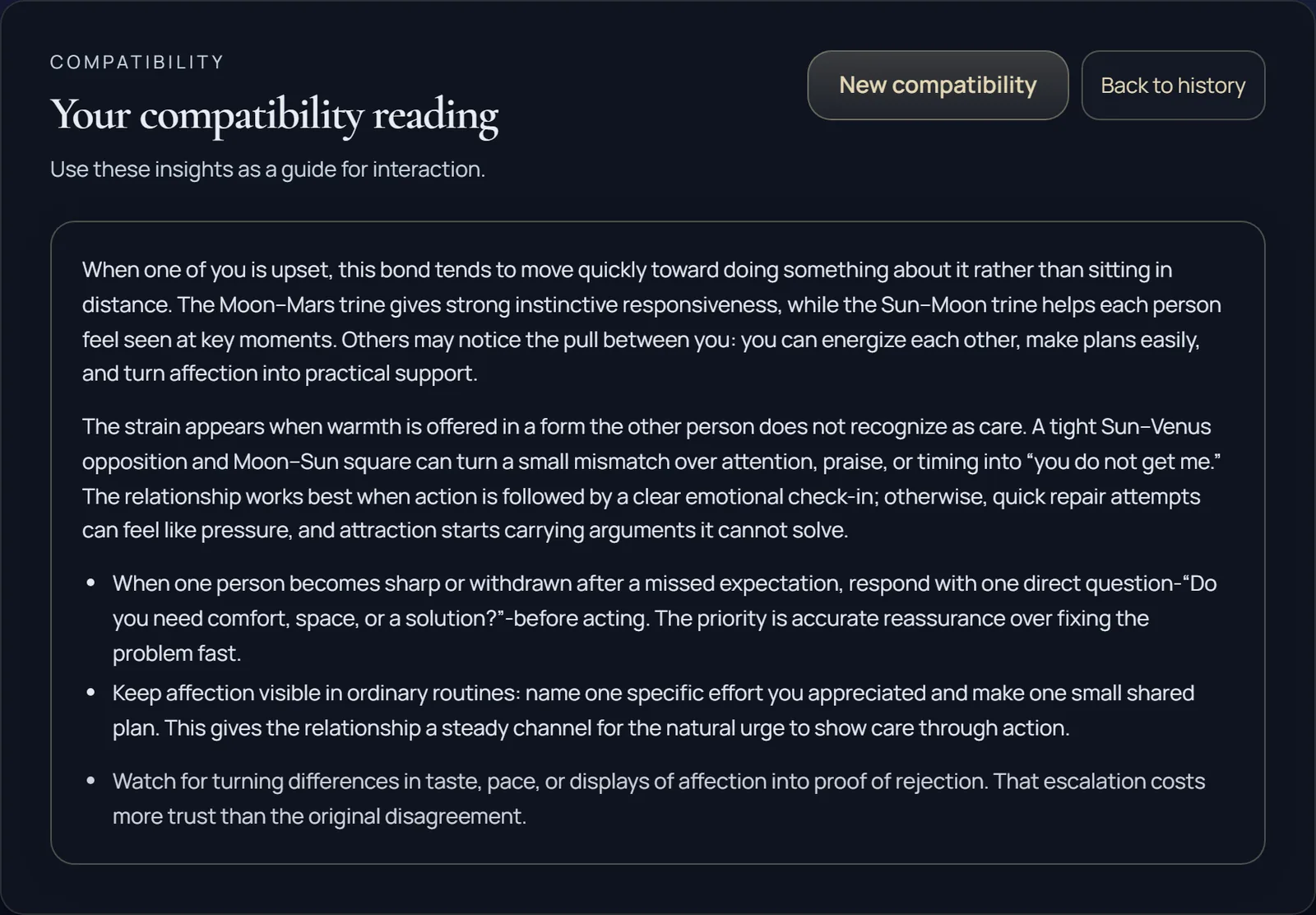
A basic sign compatibility reading might say the pair should get along. A better relationship astrology reading would separate the layers:
- Attraction layer: Venus or Mars symbolism may explain why the pull felt immediate.
- Affection layer: one person may show interest through playful contact, while the other expects steadier proof.
- Emotional layer: Moon differences may show one side needs more reassurance or more space.
- Boundary layer: Saturn or house emphasis may show hesitation around commitment, timing, or vulnerability.
That is how astrology describes relationship dynamics without turning generic. It breaks a vague story into observable patterns.
What beginners often get wrong
Treating one placement as the whole answer
No single sign or planet explains an entire love life. Venus matters, but so do the Moon, Mars, Saturn, and relationship houses.
Confusing chemistry with long-term fit
Fast attraction can be real and still not support day-to-day ease. Chemistry answers one part of the story.
Reading difficulty as doom
Tension in astrology does not automatically mean failure. It may point to difference, growth pressure, or a skill gap in timing and communication.
Ignoring context and behavior
Astrology describes patterns, not excuses. Reliability, honesty, self-awareness, and effort still matter more than any placement on paper.
How to use love astrology in a practical way
If you are learning relationship astrology, keep the reading grounded in behavior.
Ask questions like:
- What tends to create attraction here?
- How is affection likely to be shown?
- What emotional response style seems strongest?
- Where are the likely pressure points around space, trust, or commitment?
- Does this connection run on shared rhythm, or on constant adjustment?
These questions work whether you are reading a single natal chart for relationship style or comparing two charts for compatibility astrology.
The goal is not to rank people as good or bad matches. The goal is to understand the pattern of connection more clearly.
A simple order for reading a relationship-focused chart
Beginners often ask where to start. Use this order:
- Venus for attraction and affection style
- Moon for emotional needs and comfort patterns
- Mars for desire, pursuit, and friction style
- 7th house for partnership themes
- Saturn for boundaries, seriousness, and limits
After that, look at how those parts support each other or create tension.
For example:
- Venus may want warmth and visible affection.
- Moon may want privacy and slow trust.
- Mars may push for speed.
- Saturn may apply brakes.
That mix says far more than a basic sign match ever could.
FAQ
Can astrology really say who is compatible?
Not with certainty. It can describe patterns that make connection easier, more charged, more demanding, or more uneven. Compatibility is not a fixed verdict.
Which matters more in love astrology: Venus or the Moon?
They do different jobs. Venus describes attraction and affection style. The Moon describes emotional comfort and security. For long-term relationship dynamics, both matter.
Is sign compatibility useless?
No. It is just limited. Sun sign compatibility can offer a quick overview, but it misses many of the markers that shape real relationships.
What if the astrology looks difficult?
Difficult does not always mean bad. It may mean stronger differences in pacing, boundaries, or expression. The useful question is whether those differences are workable.
The bottom line
Relationship astrology becomes useful when it moves past slogans and looks at pattern, behavior, and pressure points.
For beginners, the key shift is simple: stop asking only whether two signs match. Start asking how attraction starts, how care is shown, what emotional rhythm each person needs, and where boundaries hold firm.
That is where astrology starts to describe real relationship dynamics with more clarity and less noise.